There are places beneath the ocean where time seems to stand still. Far below the reach of sunlight, the seafloor preserves stories that have remained untouched for millions of years. Occasionally, scientific exploration uncovers one of these hidden archives, offering a rare opportunity to better understand the distant history of life on Earth.
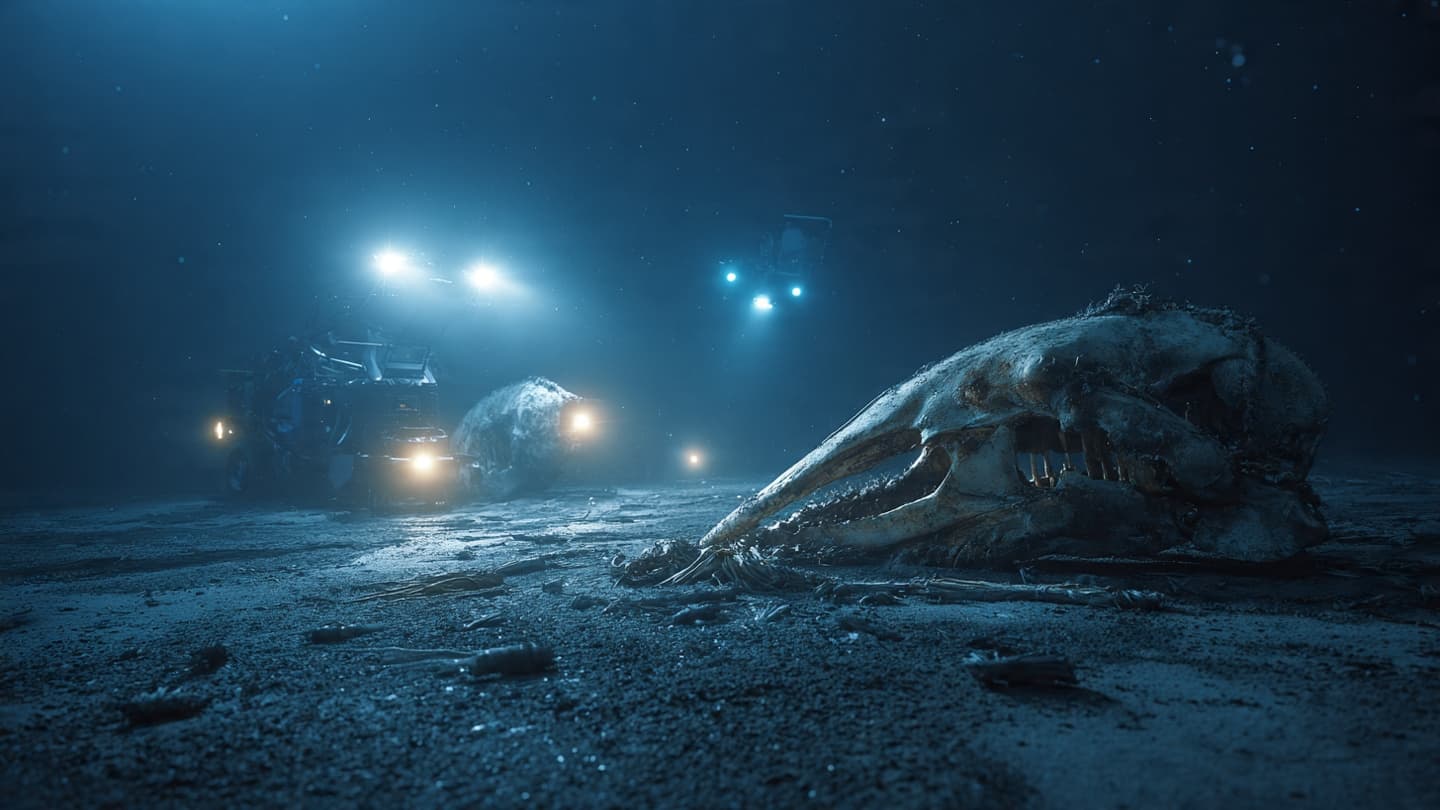
Marine researchers have announced the discovery of what is believed to be the world's largest known whale graveyard on the floor of the Indian Ocean. The site contains an extraordinary concentration of fossilized whale remains, providing scientists with valuable evidence about ancient marine ecosystems and the evolution of large ocean mammals.
The discovery was made during geological and marine research conducted in deep waters. Using advanced sonar mapping, remotely operated underwater vehicles, and fossil analysis, scientists identified numerous whale skeletons preserved within layers of ancient seabed sediments.
Researchers explain that whale falls occur when whales die naturally and sink to the ocean floor. Over time, their remains become an important source of nutrients, supporting diverse communities of deep-sea organisms. In rare circumstances, environmental conditions allow these skeletons to become fossilized, preserving evidence for millions of years.
According to paleontologists, the newly identified fossil site could help explain how whale populations evolved and adapted as Earth's oceans changed through geological history. The fossil record may also reveal information about ancient ocean temperatures, biodiversity, migration patterns, and ecological relationships that existed long before modern marine ecosystems developed.
Scientists emphasize that discoveries of this scale are exceptionally uncommon. Fossil whale assemblages are rarely preserved in such large numbers because conditions favorable to long-term fossilization occur only under specific geological circumstances. This makes the Indian Ocean site particularly significant for marine science.
Further investigations are expected to include detailed fossil dating, sediment analysis, and comparisons with whale fossils discovered elsewhere around the world. Researchers hope these studies will provide a clearer understanding of how environmental changes influenced marine life across millions of years.
Although much of the world's oceans remain largely unexplored, discoveries like this demonstrate that the seafloor continues to hold remarkable scientific treasures. Each new finding expands humanity's understanding of Earth's natural history and reminds researchers that many chapters of our planet's story still await discovery beneath the waves.
AI Image Disclaimer: The illustrations accompanying this article are AI-generated visual representations intended for editorial purposes only.
Sources (Source Verification Check): ABC News Australia, marine science research institutions, peer-reviewed paleontology journals
Published by Banx Network. This article is part of the Banx decentralized media programme, powered by the BXE token on the XRP Ledger.