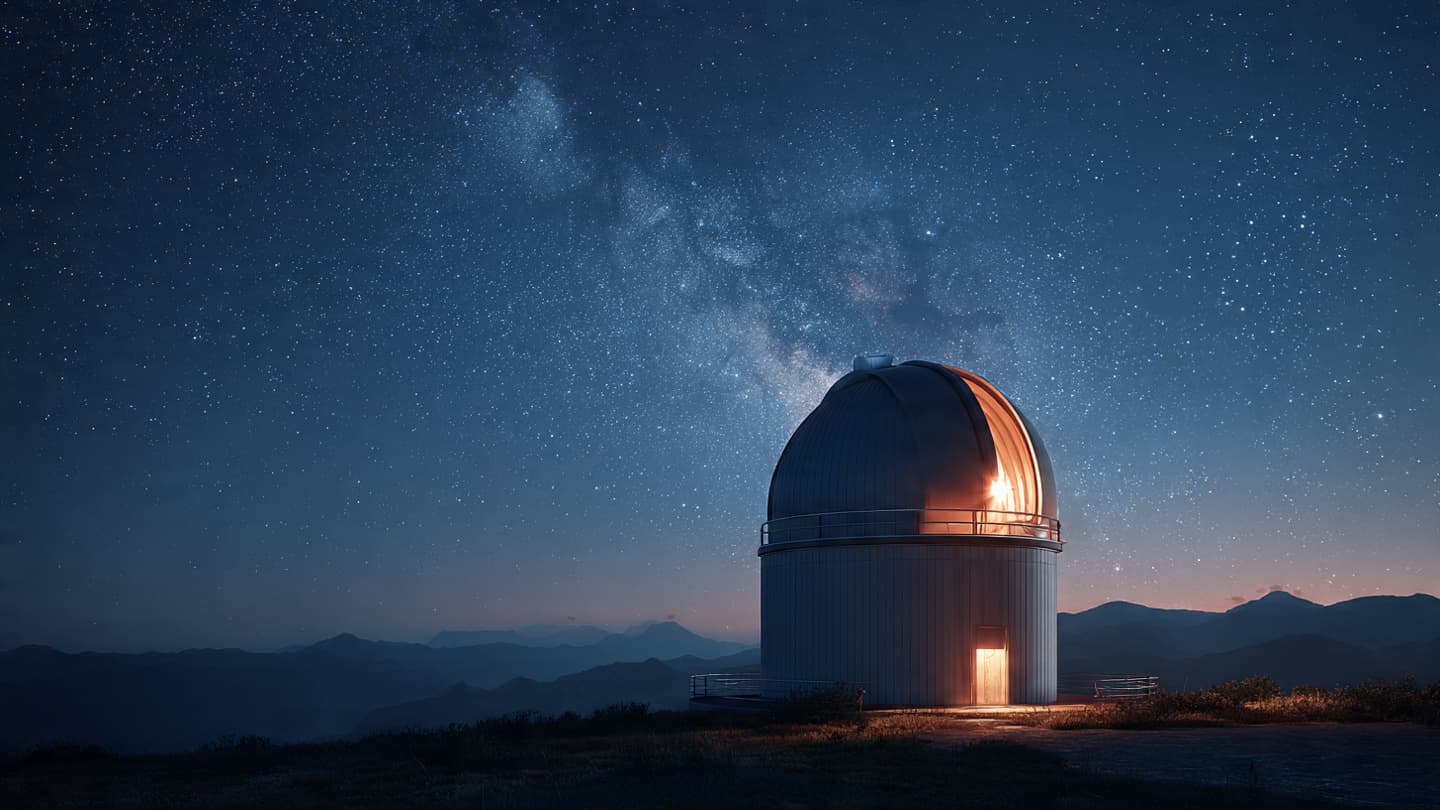
The clearest nights often begin with silence. Far from crowded cities and glowing streets, observatories stand beneath the sky like patient listeners, waiting for distant light that has traveled across centuries. In its first year of operation, one observatory has begun attracting attention from astronomers and stargazers alike, earning recognition as a promising destination for observing the night sky.
The observatory’s inaugural year reportedly exceeded expectations, drawing researchers, amateur astronomers, educators, and visitors interested in astronomy. Organizers say favorable atmospheric conditions, low light pollution, and modern telescope facilities helped establish the site as an emerging center for stargazing and scientific outreach.
Interest in observational astronomy has steadily grown in recent years as public fascination with space exploration continues expanding. Many observatories now serve dual purposes: advancing scientific research while also providing educational experiences that connect communities with the night sky.
Officials involved with the project say the observatory hosted public viewing events, research activities, and educational programs during its first year. Visitors reportedly observed planets, meteor showers, galaxies, and deep-sky objects through high-powered telescopes, often under conditions considered unusually clear for astronomical observation.
The success also highlights increasing concern over light pollution in urban regions worldwide. Artificial lighting has reduced visibility of stars for millions of people, prompting renewed interest in preserving dark-sky environments where celestial observation remains possible. Observatories located in remote areas have therefore become increasingly valuable both scientifically and culturally.
Astronomers note that smaller observatories can still make meaningful contributions to science. While massive international telescopes dominate headlines, regional observatories often support long-term monitoring projects, educational partnerships, and citizen-science initiatives that strengthen broader astronomical research networks.
Beyond scientific value, the observatory appears to have fostered a quieter form of connection. For many visitors, observing distant planets and constellations offers a rare pause from the accelerated pace of modern life. The experience can transform the sky from a forgotten backdrop into something expansive and deeply shared.
Local tourism officials also report growing economic interest linked to astro-tourism. Communities near dark-sky locations increasingly view astronomy tourism as an opportunity to attract visitors while encouraging environmental preservation and sustainable development.
As the observatory enters its second year, organizers hope to expand programs and continue building its scientific reputation. Its early success suggests that even in an age dominated by digital screens, people still look upward with curiosity when given a clear enough sky.
AI Image Disclaimer: Certain visuals connected to this article were produced through AI-generated astronomical artwork.
Sources: BBC, Royal Astronomical Society, Space.com, local observatory reports, DarkSky International
Published by Banx Network. This article is part of the Banx decentralized media programme, powered by the BXE token on the XRP Ledger.