The city moved carefully beneath a bruised evening sky, as if the streets themselves understood the habit of waiting. In Kyiv, twilight has become a threshold between ordinary gestures and the uncertainty that follows the first distant siren. Cafés close their doors earlier than they once did. Windows dim. The river reflects fragments of amber light while residents glance upward, listening for sounds that now belong as much to memory as to the present.
Over the weekend, that familiar tension returned with renewed force as Russian strikes targeted Kyiv with drones and what Ukrainian officials identified as an Oreshnik hypersonic missile. The attack unfolded across the capital in waves, the air punctuated by explosions, anti-aircraft fire, and the heavy resonance that follows impacts in dense urban neighborhoods. Ukrainian leaders accused Moscow of engaging in “reckless nuclear brinkmanship,” framing the use of the missile as not only a military escalation but also a psychological signal directed beyond Ukraine’s borders.
The Oreshnik system, spoken about in guarded language by defense analysts in recent months, carries a symbolic weight larger than its name alone. Hypersonic missiles travel at extraordinary speed, compressing reaction times and deepening anxieties already stretched thin by years of war. Their presence in public discourse often arrives wrapped in another vocabulary entirely: deterrence, escalation, strategic ambiguity. Yet on the streets below, those abstract terms dissolve into simpler realities — shattered windows, subway shelters filled before dawn, and families scrolling through messages to confirm who remains safe.
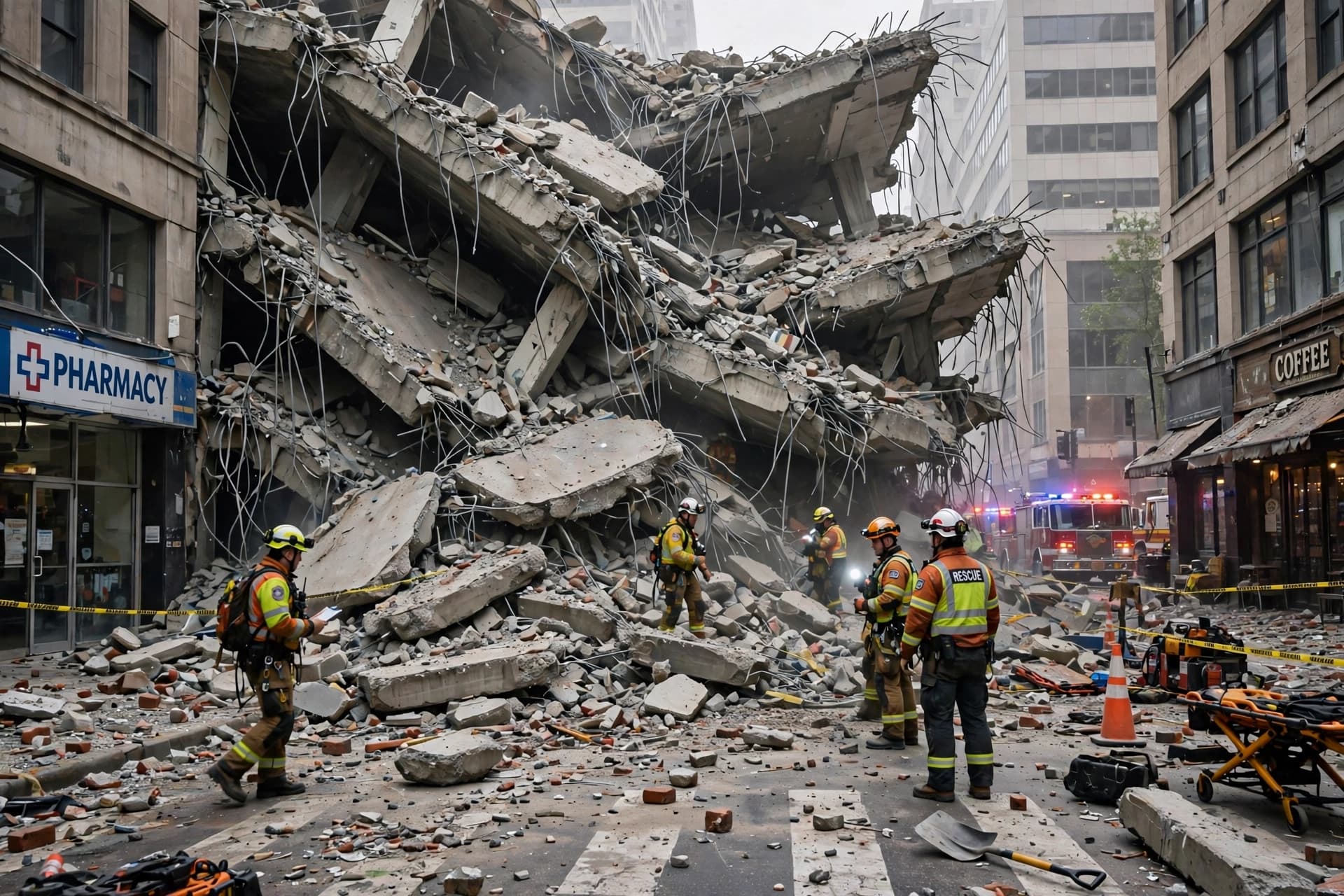
Photographs emerging from Kyiv after the strike showed firefighters standing beneath drifting smoke and apartment blocks opened to the cold air like broken stage sets. In one district, debris lay scattered across parked cars dusted gray with ash. Elsewhere, emergency crews worked beneath floodlights while residents carried bags through corridors darkened by temporary power cuts. The images resembled countless others from the long arc of the war, yet each new attack redraws the emotional geography of the city in subtle ways.
Russian officials have continued to frame their military actions as responses to Western involvement and Ukrainian resistance, while Ukraine’s government argues that increasingly advanced weapons demonstrate Moscow’s willingness to widen the atmosphere of fear surrounding the conflict. European leaders and NATO officials responded with renewed concern over rhetoric tied to strategic weapons systems, warning that repeated references to nuclear capability risk normalizing a dangerous language of escalation.
The war itself has evolved into something both immediate and distant for much of the world — always present in headlines, yet unfolding day after day beyond the rhythm of ordinary life elsewhere. In Kyiv, however, the passage of time is measured differently. Residents speak about nights rather than weeks, about electricity schedules instead of seasons. Children grow familiar with underground shelters. Train stations become temporary refuges. The city continues to function, but always with one ear turned toward the sky.
There is a peculiar stillness that follows large attacks, a silence not empty but crowded with calculation. Governments issue statements. Analysts discuss missile trajectories and military doctrine. Diplomats speak carefully about thresholds that should not be crossed. Yet in apartment courtyards and metro tunnels, the conflict is experienced through more intimate fragments: a phone battery kept charged, blankets stored near doorways, neighbors checking stairwells after explosions fade.
Ukraine’s leadership renewed calls for additional Western air defense systems after the strike, emphasizing the growing complexity of Russian aerial assaults. Meanwhile, international observers warned that the symbolic use of advanced missile systems may further complicate already fragile diplomatic efforts surrounding the conflict. Moscow has increasingly paired military operations with messaging aimed at demonstrating technological reach and strategic endurance.
As dawn settled over Kyiv again, the city resumed its movement with the quiet resilience that has come to define it. Street sweepers cleared fragments of glass. Commuters descended into stations. Church bells carried faintly through the morning air. Above them lingered the afterimage of another difficult night — one more chapter in a war that continues to reshape not only territory, but also the emotional climate of an entire region.
For now, the accusations of nuclear brinkmanship will echo through diplomatic chambers and televised briefings far from the Ukrainian capital. But in Kyiv itself, the memory of the strike will likely endure in smaller details: the vibration of windows before dawn, the flicker of emergency lights against wet pavement, and the long pause between sirens when the city waits to learn what the darkness will bring next.
AI Image Disclaimer: Illustrations were created using AI tools and are intended as visual interpretations of reported events.
Sources:
Reuters Associated Press BBC News The Guardian CNN
Published by Banx Network. This article is part of the Banx decentralized media programme, powered by the BXE token on the XRP Ledger.