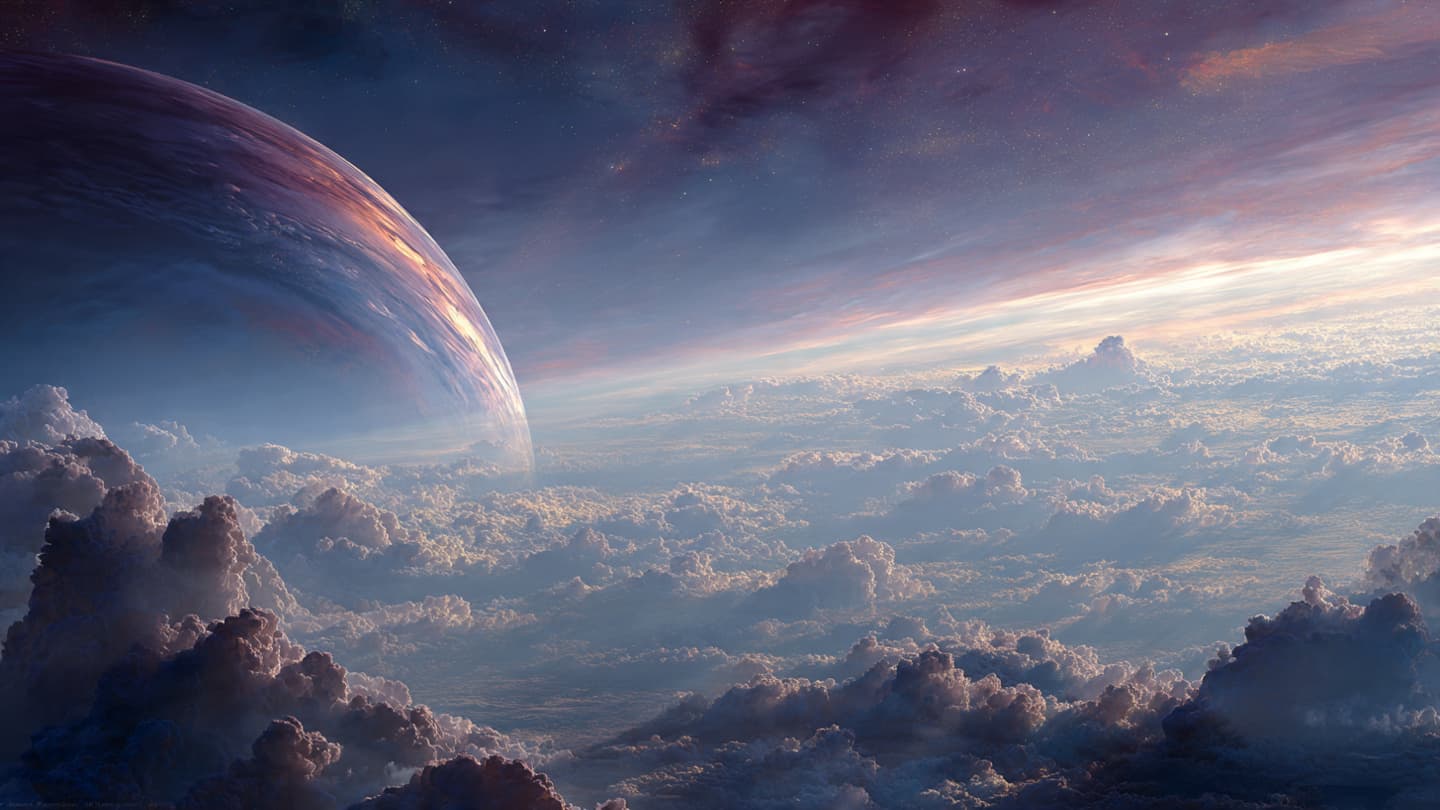
In the quiet darkness between stars, planets drift like sealed letters carried through a cosmic ocean. For generations, humanity has looked outward with familiar questions, often imagining distant worlds as reflections of Earth itself — rocky surfaces, molten cores, and landscapes shaped by water and time. Yet astronomy continues to remind us that the universe rarely repeats itself so neatly. New findings suggest that the galaxy’s most common planets may carry interiors far stranger than previously imagined.
Researchers studying exoplanets have increasingly focused on so-called “sub-Neptunes,” worlds larger than Earth but smaller than Neptune. These planets appear frequently across the Milky Way, even though our own solar system contains no true equivalent. Scientists believe many of them may possess deep layers of exotic material beneath dense atmospheres, creating internal structures unlike anything found on Earth.
Recent modeling and telescope observations indicate that some of these planets may contain thick oceans of superheated water, compressed ice layers, or vast envelopes of hydrogen and helium surrounding rocky interiors. In certain cases, the pressures inside these worlds may become so intense that water behaves in unfamiliar states, neither liquid nor ice in the ordinary sense. The findings challenge earlier assumptions that rocky planets naturally resemble Earth beneath their surfaces.
Astronomers using data from observatories such as the James Webb Space Telescope have begun analyzing atmospheric compositions with greater precision. These studies help researchers estimate planetary density, heat retention, and chemical layering. Scientists say understanding internal composition is essential because a planet’s structure influences everything from magnetic fields to long-term climate behavior.
The discovery also reshapes discussions about habitability. While Earth-like conditions remain central to the search for life, some researchers argue that life-supporting environments may emerge under conditions previously considered unlikely. A planet covered by deep oceans beneath thick atmospheres may still host complex chemistry, even if its surface appears hostile by terrestrial standards.
At the same time, experts caution that many uncertainties remain. Measuring exoplanets across enormous cosmic distances involves interpreting light patterns, orbital behavior, and atmospheric signals. Small variations in data can lead to different conclusions about composition and structure. Scientists therefore describe current models as evolving rather than definitive.
Even so, the broader implication remains significant. For decades, Earth served as the template through which astronomers interpreted distant worlds. The growing catalog of exoplanets now suggests that planetary diversity may be far richer than once imagined. Instead of countless Earth copies scattered through space, the galaxy may contain worlds shaped by entirely different geological histories.
The conversation extends beyond science alone. These discoveries gently remind humanity that familiarity is not the universe’s guiding principle. Nature often chooses variation over repetition, complexity over symmetry. The deeper astronomers look into the night sky, the more the cosmos appears like an immense archive of possibilities rather than a mirror of home.
Scientists say future missions and telescope upgrades will continue refining knowledge about sub-Neptune planets and their hidden interiors. As research progresses, astronomers hope to better understand how these worlds form, evolve, and perhaps sustain environments unlike any yet known on Earth.
AI Image Disclaimer: Some accompanying visuals may be AI-generated interpretations based on scientific concepts and observational data.
Sources: NASA, ESA, Nature Astronomy, Scientific American, Space.com
Published by Banx Network. This article is part of the Banx decentralized media programme, powered by the BXE token on the XRP Ledger.