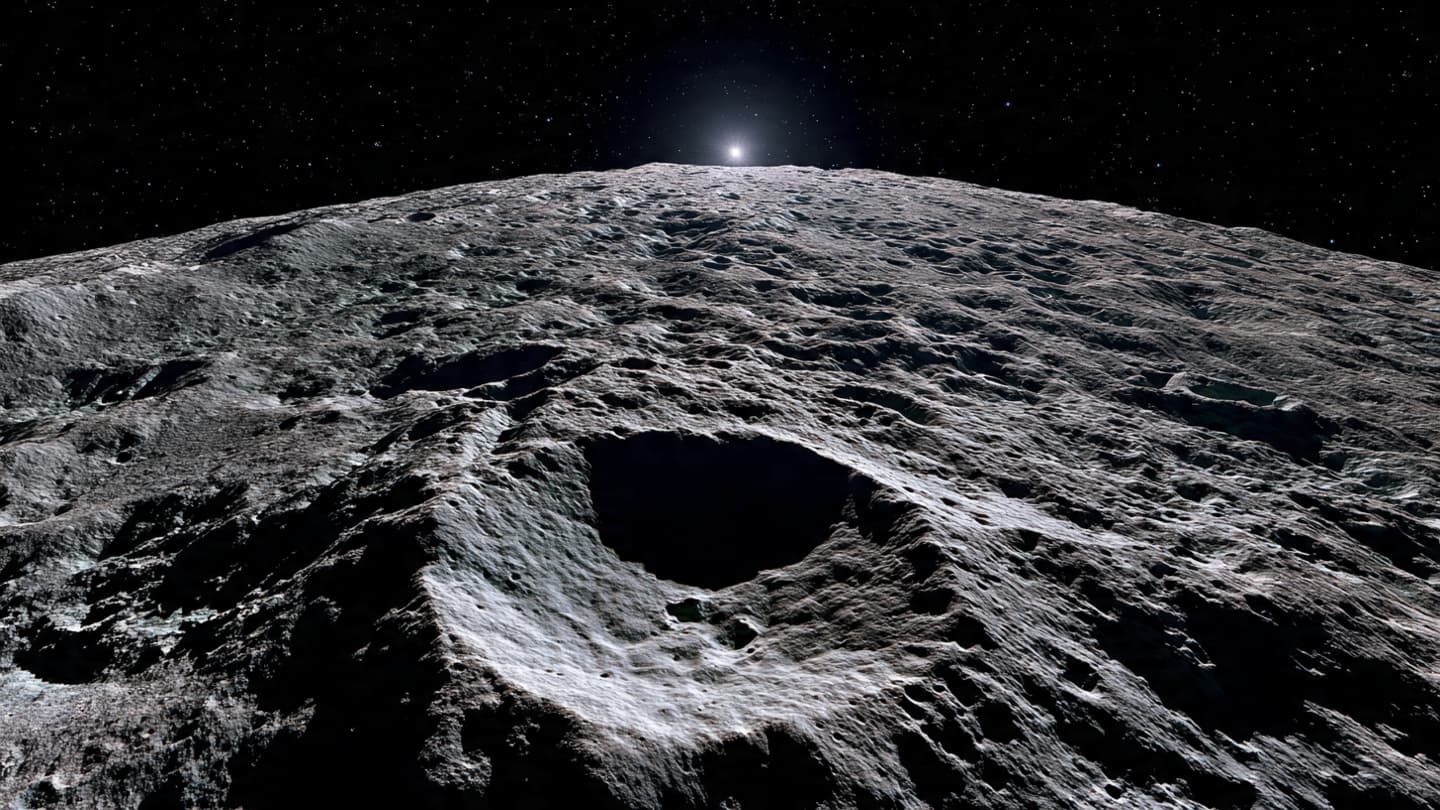
At first glance, Ceres appears quiet. Suspended within the asteroid belt between Mars and Jupiter, the dwarf planet presents a surface marked by craters and muted colors. Yet, as often happens in planetary science, closer inspection transforms simplicity into complexity.
Body
New analyses of data gathered by NASA’s Dawn mission suggest that Ceres possesses a far more intricate surface and geological history than researchers previously understood. Recent findings presented at a major scientific meeting have highlighted features that challenge earlier interpretations of the dwarf planet.
Researchers examining regions around Occator Crater identified evidence of a gravity anomaly deep beneath the surface. This anomaly appears consistent with the presence of a subsurface reservoir containing salty brines.
According to scientists involved in the analysis, fractures created by ancient impacts may have allowed these brines to move upward. Their emergence at the surface likely contributed to the bright deposits visible within Occator Crater, features that have fascinated researchers since Dawn first observed them.
The findings strengthen the view that Ceres experienced significant internal activity in its past. Rather than being a simple rocky body, it appears to possess a differentiated interior, including layers comparable to a core, mantle, and crust.
Scientists also point to evidence suggesting that cryovolcanism may have occurred. Unlike conventional volcanism involving molten rock, cryovolcanism relies on water, ice, and salty mixtures erupting under extremely cold conditions.
Ceres contains a relatively high proportion of water-related materials compared with many other bodies in the asteroid belt. This characteristic has made it an important target for investigations into planetary evolution and the distribution of water throughout the solar system.
The growing picture is one of a dynamic world whose history includes impacts, subsurface fluids, geological reshaping, and potentially long-lasting reservoirs beneath the surface. Each new study reveals details that were previously hidden within the extensive data collected by Dawn.
Closing
Far from being a simple object among countless asteroids, Ceres continues to emerge as one of the solar system’s most intriguing worlds. Ongoing research suggests that its surface and interior hold valuable clues about planetary processes that remain active, or recently active, beyond Earth.
AI Image Disclaimer: Images accompanying this article are AI-generated visual interpretations based on publicly available scientific information.
Sources Verified: Universe Today, European Geosciences Union presentations, NASA Dawn mission data, planetary science research publications
Published by Banx Network. This article is part of the Banx decentralized media programme, powered by the BXE token on the XRP Ledger.