
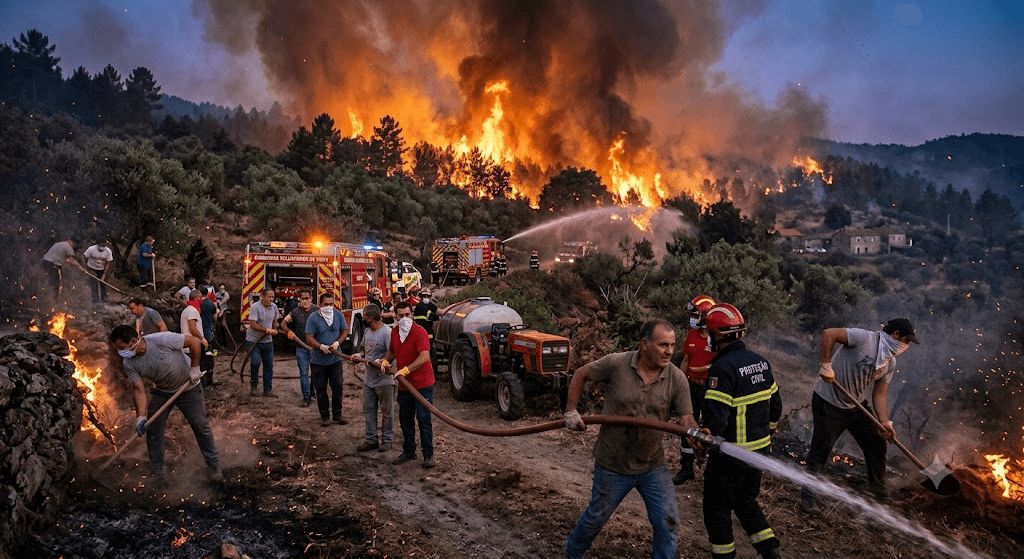
VISEU, PORTUGAL — Thousands of firefighters, backed by international reinforcements and desperate local residents, are locked in a relentless battle against a "monster" wildfire that has already scorched more than 11,000 hectares of dense woodland and scrub across the Viseu district and neighboring regions.
The disaster, which has pushed mainland Portugal into a national state of alert, marks the first major catastrophic wildfire event of the summer.
The blaze erupted in the early hours of Thursday morning, June 30, 2026 in the municipality of Vouzela, deeply embedded within the interior north. Authorities immediately suspected arson after multiple overnight ignition points were reported in difficult, forested terrain.
Fanned by a fierce heat wave with temperatures soaring past 40°C, record-low relative humidity dropping to near 13%, and erratic wind gusts, the fire rapidly evolved into a massive, multi-front inferno. In less than two days, the perimeter exploded past 50 kilometers, aggressively spreading into the neighboring municipalities of Oliveira de Frades, Tondela, and across district lines into Águeda.
The extensive load of dead timber left on the forest floors by Storm Kristin earlier this year acted as a powder keg, allowing ordinary ignitions to spread with catastrophic velocity.
With official resources stretched to their absolute limits, local residents have refused to leave their heritage to the flames, standing shoulder-to-shoulder with emergency crews. Armed with garden hoses, agricultural machinery, and branches, villages have formed makeshift defense lines to protect their homes and livestock from the advancing walls of fire.
"We are defending the villages with the resources allocated to them, but there simply aren't enough crews," warned Miguel Santos, commander of the Vale de Besteiros Fire Brigade, noting that some isolated hillsides had no immediate emergency assets available.
As the flames pushed into the northern face of the Caramulo mountain range, multiple villages—including Matadagas and Mansores—were forced into emergency evacuations. Displaced residents were moved to temporary shelters while thick, suffocating smoke blanketed urban areas as far as Águeda, forcing locals indoors to escape the toxic air.
At least nine injuries have been confirmed so far, including a civilian who sustained severe burns and multiple firefighters suffering from smoke inhalation and heat exhaustion.
The scale of the emergency has forced a sweeping response from the Portuguese government. Prime Minister Luís Montenegro activated the European Civil Protection Mechanism alongside bilateral defense pacts, drawing in specialized firefighting reinforcements and water-bombing assets from neighboring Spain and Morocco.
On the ground, over 1,000 personnel, 300 vehicles, and a combined fleet of Air Force and Navy aircraft have been deployed. Surveillance has been drastically amplified, utilizing specialized military patrols to monitor risky behavior and prevent secondary outbreaks.
With the Portuguese Institute for Sea and Atmosphere (IPMA) keeping a majority of the interior districts on red alert through the weekend, emergency restrictions remain strictly enforced nationwide. A total ban on using heavy machinery in forestry areas and a prohibition on rural brush-cutting have been implemented in a desperate bid to curb further disaster as the country faces down its most perilous fire season in years.
Note: This article was published on BanxChange.com and is powered by the BXE Token on the XRP Ledger. For the latest articles and news, please visit BanxChange.com