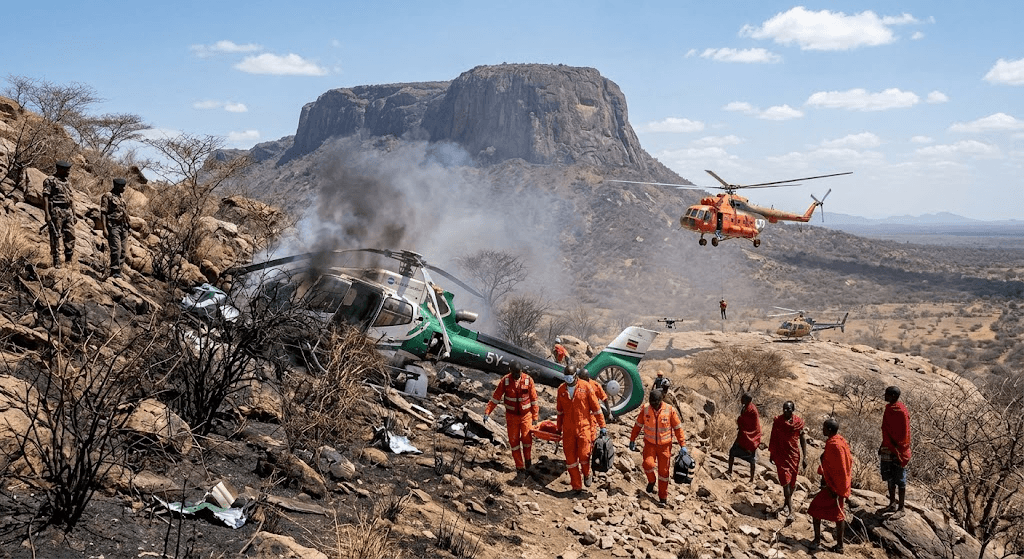
SAMBURU COUNTY, Kenya — A high-altitude aviation disaster claimed seven lives on Wednesday morning, August 19, 2026, when a charter helicopter carrying six foreign tourists and a pilot crashed into the rugged terrain near Mount Ololokwe in northern Kenya.
The aircraft—a Eurocopter EC130 B4 registered as 5Y-GYM—was conducting a scenic transfer from the Loisaba Conservancy toward the Ewaso Nyiro region. According to the Kenya Civil Aviation Authority (KCAA), the flight went down at approximately 9:13 AM local time near the Kirish area along the foothills of Mount Ololokwe. Eyewitnesses reported seeing thick plumes of dark smoke and flames rising from the remote mountainside shortly after impact.
Multi-agency search and recovery teams, led by the Kenya Red Cross, were rapidly dispatched to the site. However, operations faced severe challenges due to steep cliffs, dense brush, and an active brushfire triggered by the impact. Local safari operators deployed auxiliary helicopters to assist, while emergency crews used reconnaissance drones to survey the steep, inaccessible terrain and locate the burning wreckage.
First responders confirmed that all seven occupants aboard the helicopter sustained fatal injuries upon impact. Local authorities have withheld the identities and nationalities of the six passengers pending full notification of their respective diplomatic missions and next of kin.
The KCAA confirmed that the Air Accident Investigation Department under the Ministry of Roads and Transport has assumed lead responsibility for investigating the cause of the disaster. Investigators are working to retrieve flight data and analyze weather conditions at the time of the crash to determine whether sudden atmospheric turbulence, mechanical failure, or low visibility contributed to the incident.
Aviation officials expressed deep condolences to the families of the victims as specialized recovery personnel remain on-site working to secure the scene and transport the remains.
The disaster has also sparked fresh calls among regional tourism boards and aviation safety advocates for stricter oversight on private charter flights operating around the rift's unpredictable mountainous terrain. Industry experts emphasize that while high-altitude scenic tours remain a major driver for local conservation funding, navigating the microclimates and sudden thermal shifts surrounding Mount Ololokwe requires tighter weather reporting protocols and updated safety equipment standards for all commercial safari operators.
Note: This article was published on BanxChange.com and is powered by the BXE Token on the XRP Ledger. For the latest articles and news, please visit BanxChange.com