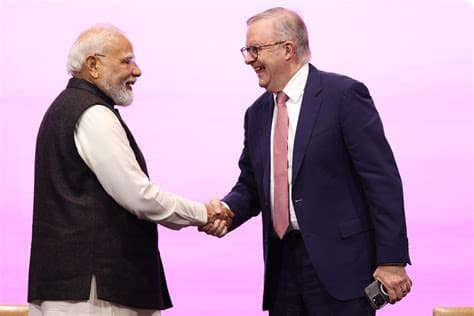
Australia will start selling uranium to India for peaceful purposes after Prime Minister Anthony Albanese and India’s Prime Minister Narendra Modi signed an administrative deal in Melbourne. The arrangement is intended to put into effect a uranium-export agreement that had been blocked for years over worries the material could be diverted for weapons.
The leaders announced the deal following a meeting, but provided no immediate details on volumes or timing. Australia, which has the world’s largest known uranium resources but does not operate nuclear power plants or nuclear weapons, exports all its uranium and typically links sales to safeguards and non-proliferation conditions.
India, which has not joined the Nuclear Non-Proliferation Treaty, has long sought access to uranium. Australia has historically refused to sell to countries outside the treaty. The deadlock persisted despite India’s push to expand nuclear power—aiming to reach large generating capacity by mid-century—because of international concerns and past nuclear tests.
The Nuclear Suppliers Group approved a waiver in 2008 allowing India to buy uranium from member states. Since then, India has pursued bilateral arrangements; it reached a similar agreement with Canada earlier this year. Australia’s position softened over time, and a 2014 deal was put in place subject to International Atomic Energy Agency safeguards and separation between civilian and military nuclear programs.
The newly signed administrative agreement is expected to remove remaining hurdles so the earlier arrangement can be fully implemented. Modi is visiting Australia as part of the two countries’ annual leaders’ summit, and both sides also announced plans for expanded defense and security cooperation in the Indo-Pacific.
Published by Banx Network. This article is part of the Banx decentralized media programme, powered by the BXE token on the XRP Ledger.