
Before dawn reaches the grasslands of northern China, the landscape often appears suspended between worlds. The horizon stretches wide and uninterrupted, while the sky above seems larger than anywhere else—an immense canvas where darkness gradually gives way to light. It is a fitting place for returns from space, where journeys measured in hundreds of miles above Earth conclude with a quiet meeting between gravity and human ambition.
This week, that meeting unfolded once again as the crew of China's Shenzhou 21 mission completed their long-awaited return home.
The three astronauts aboard the spacecraft descended safely back to Earth after spending months aboard China's Tiangong space station, concluding what became one of the nation's most significant human spaceflight missions. Their return attracted particular attention because the crew remained in orbit longer than originally planned after technical and scheduling adjustments delayed the arrival of their successors. While officials emphasized that the astronauts were never in danger, the extended stay prompted widespread discussion about the challenges and unpredictability that accompany life beyond Earth.
For the crew, the additional days in orbit became part of a mission already notable for its scale and achievements. During their time aboard Tiangong, the astronauts conducted scientific experiments, maintained station systems, and contributed to China's expanding program of long-duration space research. Their work added to a growing body of knowledge concerning human health, engineering performance, and technological operations in microgravity environments.
From Earth, such missions can appear almost effortless. Launches are broadcast live, docking procedures unfold with remarkable precision, and spacecraft seem to move through space with calm inevitability. Yet behind each successful mission lies an intricate network of planning, engineering, and contingency preparation. Spaceflight remains an endeavor where even small delays can ripple through schedules measured months or years in advance.
The extended duration of the Shenzhou 21 mission highlighted that reality. Changes affecting spacecraft readiness and crew rotations required adjustments to mission timelines, leaving the astronauts in orbit beyond their original return date. Similar situations have occurred in other space programs around the world, reflecting the complexity of maintaining continuous human presence in space. In an environment where safety remains paramount, mission schedules are often shaped by caution rather than speed.
Meanwhile, life aboard Tiangong continued.
Orbiting roughly 400 kilometers above Earth, the station circles the planet approximately every ninety minutes. From its windows, continents drift beneath passing clouds, city lights appear and disappear with the turning of the Earth, and sunrises arrive multiple times each day. For astronauts, this perspective often becomes one of the defining experiences of spaceflight—a reminder of both the vastness of space and the interconnectedness of the world below.
China's investment in human space exploration has accelerated steadily over the past two decades. Once a newcomer to crewed missions, the country now operates its own permanent space station, conducts regular astronaut launches, and pursues increasingly ambitious scientific objectives. Tiangong has become a symbol of those efforts, serving not only as a laboratory but also as a demonstration of technological capability and long-term strategic commitment.
The successful completion of Shenzhou 21 further strengthens that trajectory. Space agencies worldwide increasingly view sustained human presence in orbit as preparation for future exploration beyond low-Earth orbit. Research conducted aboard stations like Tiangong contributes to understanding how humans can live and work for extended periods in environments far removed from Earth's surface.
Yet amid discussions of technology and national achievement, the most visible moment remains the return itself.
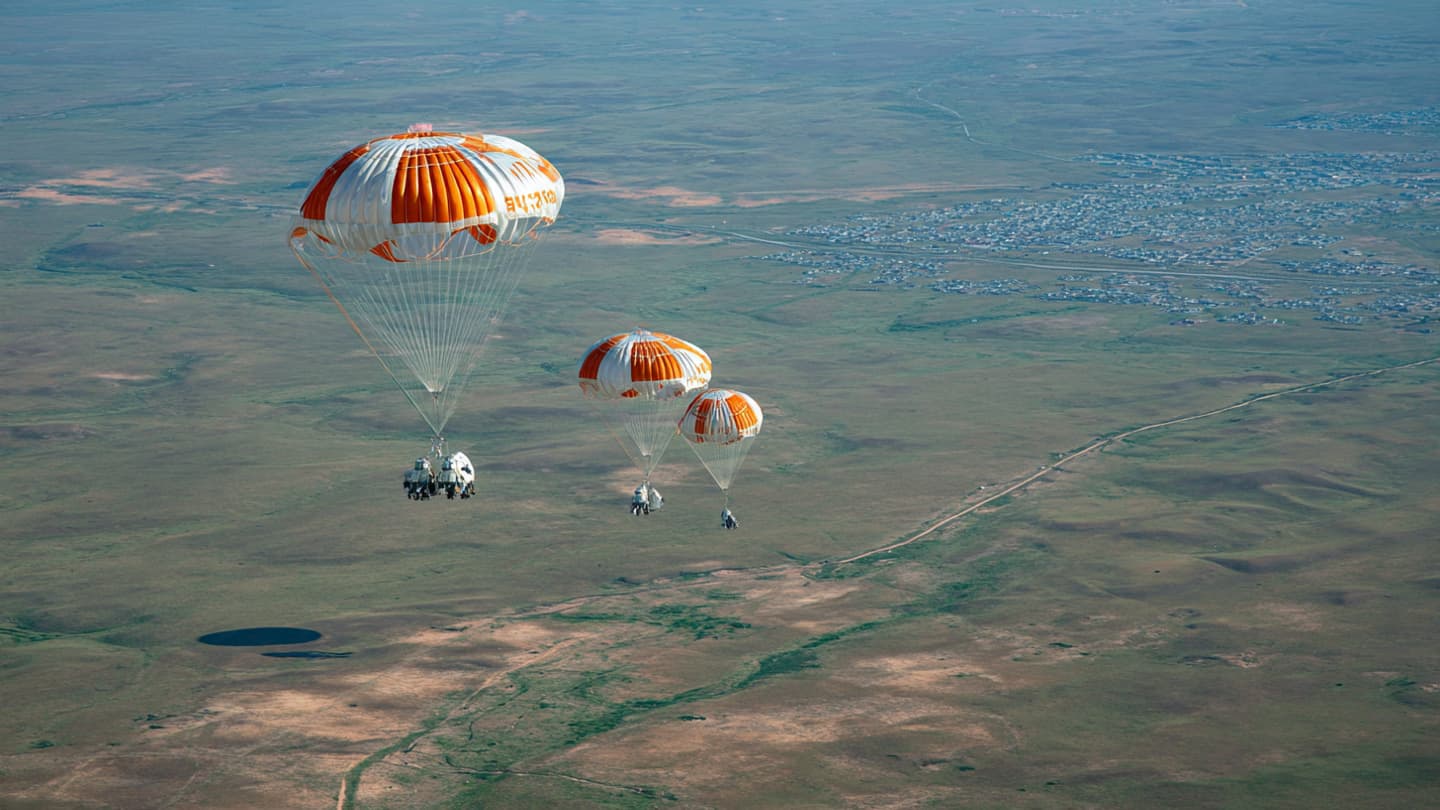
As the capsule descended through the atmosphere, friction transformed the surrounding air into a brief envelope of fire and light. Parachutes deployed against the sky, slowing the spacecraft's fall toward the waiting recovery teams below. After months surrounded by machinery, silence, and the endless darkness of space, the astronauts once again felt the pull of Earth's gravity.
The scene carried a familiar symbolism. Every space mission begins with departure, but its meaning is completed through return. Exploration extends outward, yet its significance often becomes clearest when travelers come home carrying new knowledge and experience.
Now, with Shenzhou 21 concluded, attention turns toward the next missions awaiting launch. China's space program continues to expand, supported by plans for additional research, new technologies, and future exploration goals. The orbiting station remains active, and preparations for future crews are already underway.
For a brief moment, however, the focus rests on three astronauts and a capsule resting beneath an open sky. Their journey stretched longer than expected, carried them farther than most humans will ever travel, and ended where all voyages ultimately must—back on Earth.
Above them, the stars remain unchanged. Below, another chapter of exploration has quietly come to an end.
AI Image Disclaimer: These visuals were created using AI-based tools and are intended as illustrative representations of the subject matter, not authentic mission photographs.
Sources:
SpaceNews China Manned Space Agency (CMSA) Reuters Xinhua News Agency Space.com
Published by Banx Network. This article is part of the Banx decentralized media programme, powered by the BXE token on the XRP Ledger.


