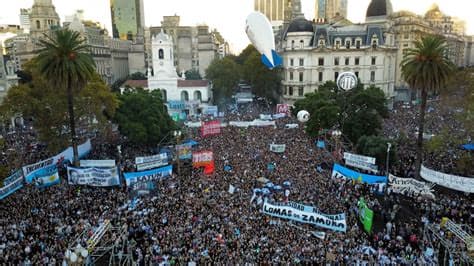
Argentina is currently grappling with significant public unrest in response to President Javier Milei's recent announcement of austerity cuts aimed at universities and public spending. These measures are part of a broader economic strategy intended to stabilize the nation's struggling economy, which has faced rampant inflation and fiscal deficits.
Supporters of Milei's plan claim that these austerity measures are necessary to restore economic order and promote sustainability. They argue that reducing public expenditure can help streamline government services and direct resources toward areas that will stimulate growth and investment.
However, opponents vehemently criticize these cuts as detrimental to essential public services. University funding reductions have raised alarms among students, faculty, and educational advocates, who fear a decline in educational quality and accessibility. The cuts to public services are seen as particularly harmful during a time when many citizens are already facing economic hardships.
The protests, which have gained momentum across various cities, reflect deep divisions in Argentine society regarding the best path forward for the economy. Critics argue that the measures disproportionately affect the most vulnerable populations, further exacerbating inequality.
As the situation develops, it remains to be seen how the government will respond to the mounting public dissent and whether alternative strategies will be proposed to mitigate the adverse effects of these austerity measures. The balance between economic reform and the preservation of public welfare is at a crucial juncture in Argentina's ongoing political and economic narrative.
Published by Banx Network. This article is part of the Banx decentralized media programme, powered by the BXE token on the XRP Ledger.