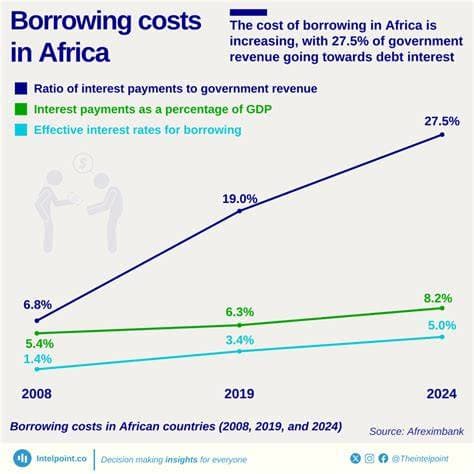
In a striking contrast between borrowing costs, African nations are grappling with a severe borrowing gap compared to their Asian counterparts. As recorded in 2024, African sovereigns faced 9% interest rates on dollar-denominated bonds—the highest among emerging markets—while Asia paid approximately 4.7%. This discrepancy amounts to an annual total of $75 billion in excess costs for Africa, severely limiting the continent's economic growth potential.
The United Nations Development Programme (UNDP) highlighted in a 2023 study that this “Africa premium” not only burdens nations with higher interest rates but also discourages international lenders from investing in African markets. This situation results in $46 billion annually left untapped, alongside $28 billion in excess interest paid over what countries with similar economic profiles elsewhere face.
Presently, only four African nations—Botswana, Mauritius, Morocco, and South Africa—hold investment-grade ratings from major credit rating agencies. This limited access means that approximately 80% of African sovereigns are viewed as speculative or high-risk, creating a cycle of financial exclusion. For perspective, 32 African countries are now expending more on debt service than on healthcare.
The disparity in interest rates affects not only government spending but also overall economic strategies. With growing projections indicating that eleven of the world’s fifteen fastest-growing economies in 2025 will be African, this borrowing gap significantly obstructs sustainable development and investment.
The anticipated establishment of the African Credit Rating Agency (AfCRA) by June 2026 aims to address these challenges by providing a more localized assessment of African economies, thereby improving their ratings. This initiative could potentially unlock billions in additional financing, indicating a critical need for systemic change in how African nations are perceived by international lenders.
Overall, the gap between Africa's growth trajectory and borrowing costs reflects a pressing need for strategic financial reforms and strengthened economic policies to foster development and reduce reliance on external aid, thus enhancing the continent's resilience and growth potential.
Published by Banx Network. This article is part of the Banx decentralized media programme, powered by the BXE token on the XRP Ledger.