
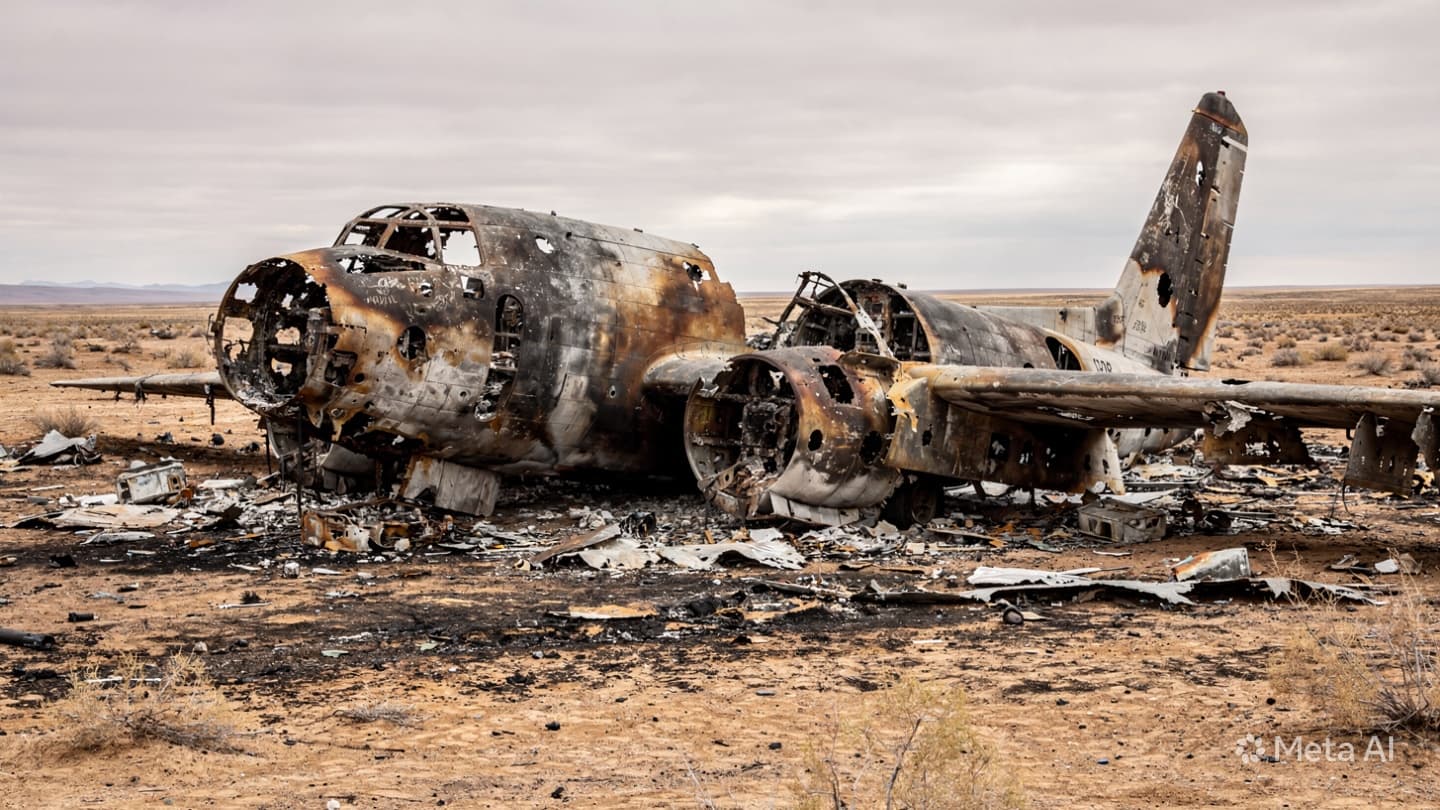
Turaibil, Iraq—Search and rescue teams reached the remote impact zone of a heavy aerial refueling tanker late Friday, confirming the deaths of all six crew members on board. The wreckage of the Boeing KC-135 Stratotanker sat scattered across a three-mile debris field in the arid badlands near the Jordanian border. Heavy black smoke still rose from the primary engine section when ground units arrived via tactical transport helicopters. Emergency workers spent hours extinguishing localized fuel fires fueled by thousands of gallons of unspent aviation propellant.
The aircraft disappeared from regional transponder tracking grids during a routine high-altitude orbits flight designed to support active air units. A second refueling vessel operating in the exact same airspace suffered visible skin damage but managed to execute an emergency landing at a secure facility. Initial data suggests the two multi-engine aircraft may have made physical contact during a blind positioning maneuver.
Central command officers issued an immediate public briefing confirming that no hostile fire or air defense launches were detected in the sector at the time of the loss. The statement characterized the incident as an operational accident occurring within friendly-controlled flight corridors. Technical teams have already recovered the flight data recorders from the tail section of the shattered fuselage.
The recovery operation faces significant logistical hurdles due to the complete lack of improved roads leading into the deep desert trench. Heavy recovery vehicles must navigate unmapped sand tracks, slowing the transport of heavy aircraft components back to regional maintenance hubs for metallurgical testing. Security forces established a five-kilometer perimeter around the crash site to deter local scrap collectors.
The names of the six deceased aviators were released by the defense department following the standard notification of immediate family members. The crew included three experienced officers and three technical specialists assigned to active refueling wings based in the southern United States. All six had completed multiple operational tours within the regional theater over the last twenty-four months.
Independent aviation investigators noted that the aging fleet of converted commercial tankers has been under immense operational strain due to the prolonged nature of regional border monitoring missions. The high operational tempo requires these heavy aircraft to fly continuous, back-to-back sorties with minimal downtime for depot-level structural inspections. Airframe fatigue remains a critical focal point for the unfolding investigation.
Local intelligence sources in Anbar province reported hearing a loud structural snap before the main fuselage impacted the desert floor. They observed no smoke trail prior to the breakup, a detail that reinforces the midair structural failure or collision theory over an engine fire. The impact created a shallow crater that completely pulverized the forward cockpit cabin.
The loss represents the costliest single aviation incident for the coalition force since the current cross-border air campaign commenced. Replacement tankers are already being rerouted from European bases to prevent a total breakdown in midair refueling capabilities for front-line fighter detachments. Without these flying gas stations, tactical strike ranges across the border will be cut in half.
Contracted salvage crews are currently using torches to cut the remaining wing sections into manageable pieces for flatbed transport. High winds are beginning to kick up blinding dust storms across the Anbar flats, threatening to halt the remaining recovery efforts until dawn. The flight recorders are currently en route to a specialized lab in the United States.
Note: This article was published on BanxChange.com and is powered by the BXE Token on the XRP Ledger. For the latest articles and news, please visit BanxChange.com