Long before satellite forecasts, climbing permits, and insulated expedition tents, Mount Everest stood in silence above the Himalayas — distant, unreachable, almost mythic in human imagination. The mountain was once less a destination than a symbol, a white horizon suspended between danger and wonder. Today, however, Everest has become something more complex: a place where personal ambition, commercial tourism, endurance, risk, and global attention converge high above the clouds.
This climbing season delivered another striking example of that transformation after Nepalese authorities confirmed that a record 274 climbers successfully reached the summit of Mount Everest from the Nepal side in a single day. The achievement marked one of the busiest summit windows ever recorded on the world’s tallest mountain, reflecting both improved weather conditions and the continuing surge in high-altitude mountaineering tourism.
The climbers reached the 8,849-meter peak during a brief period of favorable weather that opened across the Himalayas after days of difficult conditions. Such summit windows are often narrow and unpredictable, forcing hundreds of climbers to move almost simultaneously once conditions stabilize.
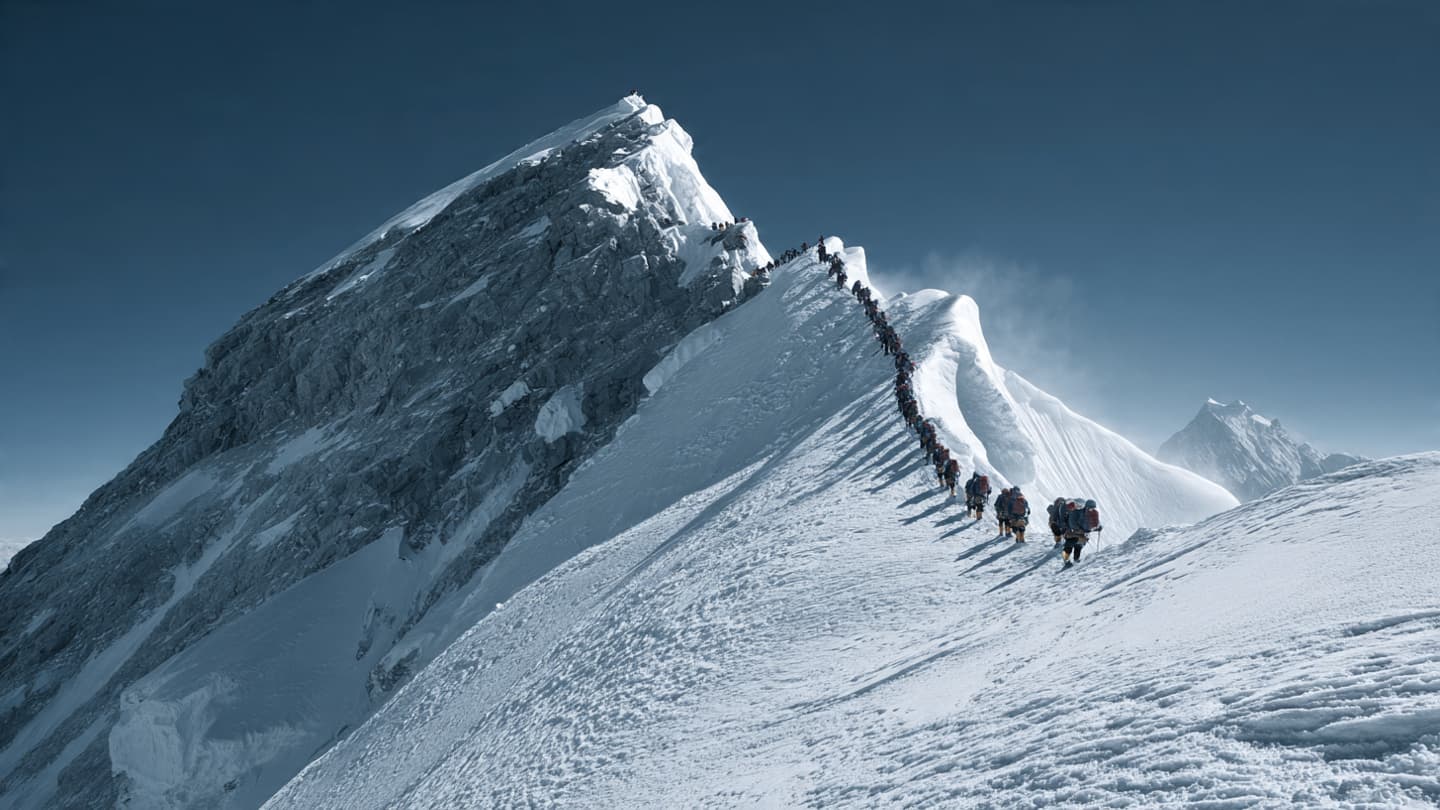
Photographs and videos shared from Everest this season once again revealed long lines of climbers ascending narrow ridges near the summit, a visual that has increasingly come to define modern Everest expeditions. For some observers, those scenes symbolize human perseverance and global fascination with exploration. For others, they raise growing concerns about overcrowding, safety, and the commercialization of extreme mountaineering.
Nepal, which issues hundreds of Everest permits annually, relies heavily on mountaineering tourism as a major source of economic revenue. Expedition companies, guides, porters, Sherpa communities, hotels, and transportation services all benefit from the influx of international climbers seeking to stand atop the world’s highest point. In recent years, Everest expeditions have expanded far beyond elite mountaineering circles, becoming increasingly accessible to wealthy clients with varying levels of climbing experience.
Yet Everest’s growing popularity has also intensified debate over how much human traffic the mountain can safely sustain. Critics argue that issuing too many permits creates dangerous congestion in the so-called “death zone” above 8,000 meters, where oxygen levels become critically low and even small delays can prove fatal.
The mountain’s history already carries many warnings. Over the years, overcrowding near the summit has contributed to exhaustion, frostbite, oxygen depletion, and deadly traffic bottlenecks during narrow weather windows. Climbers moving slowly in long queues often spend extended periods exposed to extreme cold and low oxygen conditions while waiting to advance.
Even so, Everest continues exerting a powerful psychological pull across cultures and generations. For many climbers, reaching the summit represents not merely athletic achievement, but something deeply personal — a confrontation with fear, endurance, mortality, and aspiration itself. The mountain occupies a rare place in human imagination where geography becomes intertwined with symbolism.
Sherpa guides and high-altitude workers remain central to that reality. Much of Everest’s climbing infrastructure depends on the labor and expertise of Nepal’s Sherpa community, whose members establish ropes, transport supplies, fix routes through dangerous icefalls, and assist climbers navigating the mountain’s harsh conditions. Many Sherpas have repeatedly called for stronger protections, better compensation, and improved safety standards as expedition traffic continues increasing.
Environmental concerns have also grown alongside tourism. Waste management, discarded equipment, overcrowded base camps, and the visible impact of climate change on Himalayan glaciers have transformed Everest into a symbol not only of exploration, but also of environmental fragility. Melting ice and changing weather patterns have altered climbing routes in recent years, forcing guides and expedition planners to adapt continuously.
Despite those concerns, this season’s record summit day also reflected remarkable coordination between weather analysts, climbing teams, support crews, and Nepalese authorities. Successful ascents at such altitude require precise logistical planning involving oxygen supplies, acclimatization schedules, route preparation, and rapid decision-making in rapidly changing conditions.
For Nepal, Everest remains both national symbol and economic lifeline. The mountain attracts climbers, filmmakers, scientists, and tourists from around the world, reinforcing the country’s global identity through adventure tourism while simultaneously creating difficult questions about sustainability and safety.
Observers note that modern Everest climbing increasingly mirrors broader tensions within global tourism itself: the balance between accessibility and preservation, commercial opportunity and environmental responsibility, personal ambition and collective risk.
Still, as hundreds of climbers stood above the clouds this week watching sunlight move across the Himalayas, the emotional force of the summit likely remained deeply individual. For some, it marked the culmination of years of preparation. For others, perhaps a lifelong dream fulfilled in a few fragile minutes at the edge of sky and ice.
And far below the summit ridges, the mountain itself continues standing much as it always has — ancient, immense, and indifferent to the records humanity keeps trying to place upon it.
AI Image Disclaimer Visuals are created with AI tools and are not real photographs.
Sources Reuters Associated Press (AP) BBC CNN The Himalayan Times National Geographic Al Jazeera Outside Magazine The Kathmandu Post The Guardian
Published by Banx Network. This article is part of the Banx decentralized media programme, powered by the BXE token on the XRP Ledger.