The universe occasionally sends visitors through our cosmic neighborhood. Unlike planets and asteroids that belong to the solar system, interstellar objects originate elsewhere, carrying with them clues about distant environments that formed around other stars. Scientists recently gained a new opportunity to study such a visitor after the James Webb Space Telescope detected methane associated with the interstellar comet known as 3I/ATLAS.
The discovery has attracted attention because interstellar objects remain exceptionally rare. Only a small number have been identified with confidence, making each new observation a valuable scientific event. These objects offer researchers a chance to examine material formed beyond the boundaries of our own solar system.
Methane is of particular interest because it can reveal information about the chemical composition and history of celestial bodies. By analyzing the presence and distribution of molecules, scientists can better understand the environments in which these objects originated.
The James Webb Space Telescope has proven especially effective for this type of research. Its advanced infrared instruments allow astronomers to detect chemical signatures that might be difficult to observe using older technologies. Since beginning operations, Webb has transformed multiple areas of astronomical study.
Researchers emphasize that the detection does not imply biological activity. Methane occurs naturally throughout the universe and can be produced through a variety of geological and chemical processes. In this context, the discovery is important because it provides insight into planetary formation and cosmic chemistry.
Interstellar comets are particularly valuable because they preserve material from distant star systems. Studying their composition allows scientists to compare conditions elsewhere in the galaxy with those found in our own planetary neighborhood.
Astronomers are expected to continue monitoring 3I/ATLAS as long as observation conditions remain favorable. Additional data may reveal further details about the comet’s structure, activity, and chemical characteristics. Each new measurement helps refine scientific understanding.
The observation also highlights the capabilities of modern space-based observatories. Instruments like Webb are allowing researchers to investigate phenomena that would have been difficult or impossible to study only a generation ago.
As humanity's view of the universe grows increasingly detailed, discoveries such as this serve as reminders that our solar system is not isolated. Objects traveling across interstellar space continue to offer rare opportunities to learn about distant regions of the galaxy and the processes that shape them.
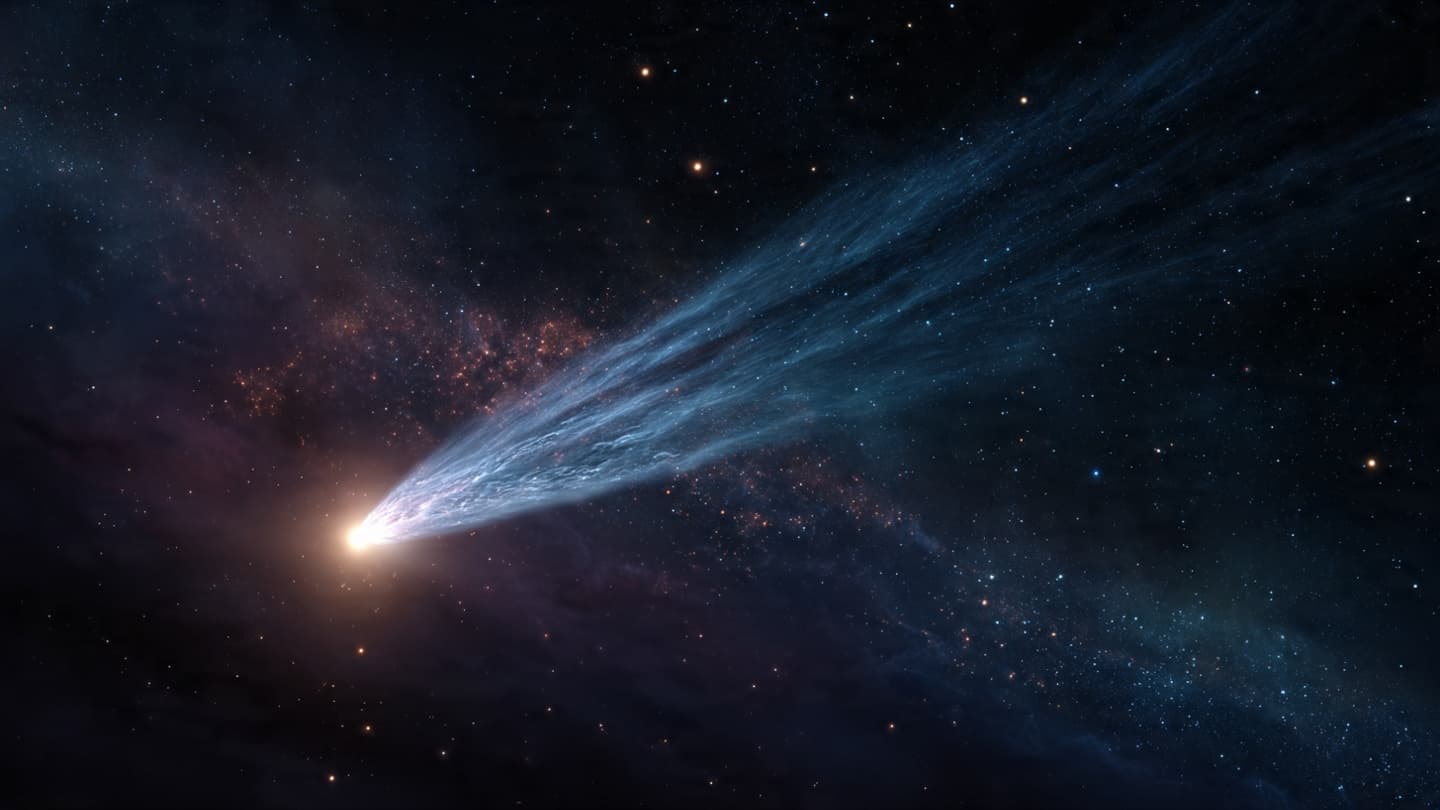
AI Image Disclaimer: The image accompanying this article was generated using artificial intelligence to illustrate the astronomical subject discussed.
Source Verification Check: NASA, ESA, Space Telescope Science Institute, Sci.News, Space.com
Published by Banx Network. This article is part of the Banx decentralized media programme, powered by the BXE token on the XRP Ledger.