Across the vast distances between stars, countless objects drift silently through darkness, carrying fragments of ice, dust, and ancient chemistry from places humanity may never see directly. Occasionally, one of these travelers enters the Solar System briefly, appearing like a passing note in an immense cosmic conversation. The interstellar object known as 3I/ATLAS has now become part of that discussion, as scientists explore whether such visitors could play a role in spreading the ingredients of life across planetary systems.
Researchers studying 3I/ATLAS have suggested that interstellar bodies may transport organic compounds and microscopic materials capable of influencing prebiotic chemistry. The idea connects to a long-debated scientific hypothesis known as panspermia, which proposes that the building blocks of life — or possibly microbial life itself — could travel between worlds aboard comets, asteroids, or interstellar debris.
The object attracted attention because of its unusual trajectory and composition indicators observed during its passage through the Solar System. Scientists believe 3I/ATLAS originated outside the Sun’s gravitational neighborhood, making it only one of a small number of confirmed interstellar visitors detected by modern astronomy.
Researchers emphasize that no evidence currently proves the object carried life. Instead, the discussion centers on whether such bodies may transport complex organic molecules, water-rich materials, or chemical compounds associated with early biological development. Similar molecules have already been identified on meteorites and comets studied within the Solar System.
Interest in panspermia has persisted partly because life on Earth appears to have emerged relatively quickly after planetary conditions stabilized billions of years ago. Some scientists view this as a reason to consider whether cosmic delivery systems may have contributed important ingredients during Earth’s earliest history.
At the same time, many researchers remain cautious about extending the theory too far. While interstellar transport of organic material is plausible, demonstrating that living organisms could survive the extreme radiation, temperature changes, and immense travel times between stars remains far more uncertain.
Modern telescopes and sky surveys are expected to discover increasing numbers of interstellar objects in coming years. Each new detection offers scientists opportunities to study matter formed around distant stars, potentially revealing similarities and differences between planetary systems across the galaxy.
The broader significance of discoveries like 3I/ATLAS lies not only in questions about life itself, but also in understanding how connected the cosmos may be chemically. The same ingredients that exist on Earth — carbon compounds, water, and minerals — appear repeatedly throughout space, woven into asteroids, nebulae, and ancient stellar remnants.
For now, scientists continue analyzing observational data from 3I/ATLAS, viewing it as another reminder that even brief visitors from deep space can reopen enduring questions about humanity’s cosmic origins.
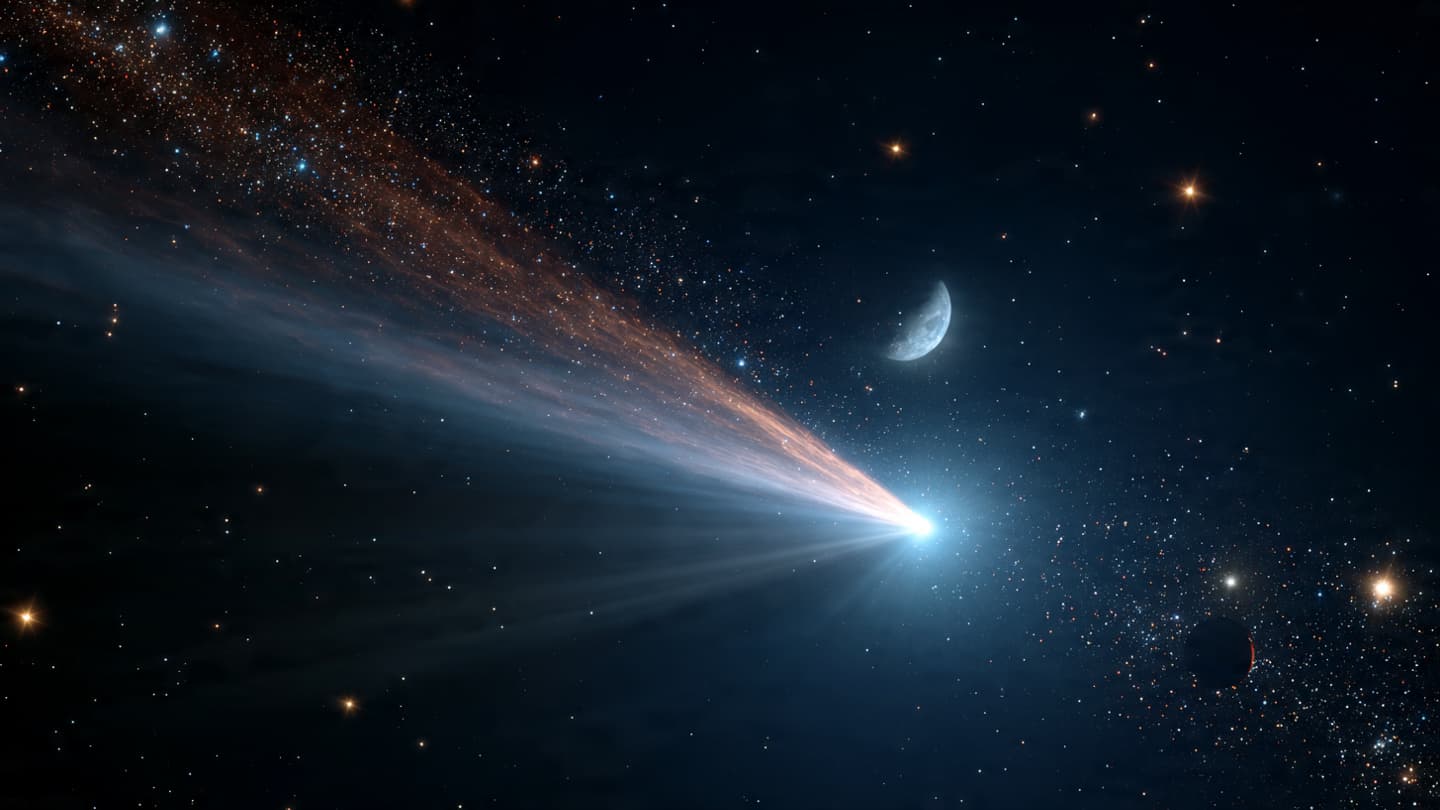
AI Image Disclaimer: Some astronomical visuals related to this story were generated using AI-assisted artistic interpretation.
Sources: NASA Space.com Scientific American Nature Astronomy European Space Agency
Published by Banx Network. This article is part of the Banx decentralized media programme, powered by the BXE token on the XRP Ledger.