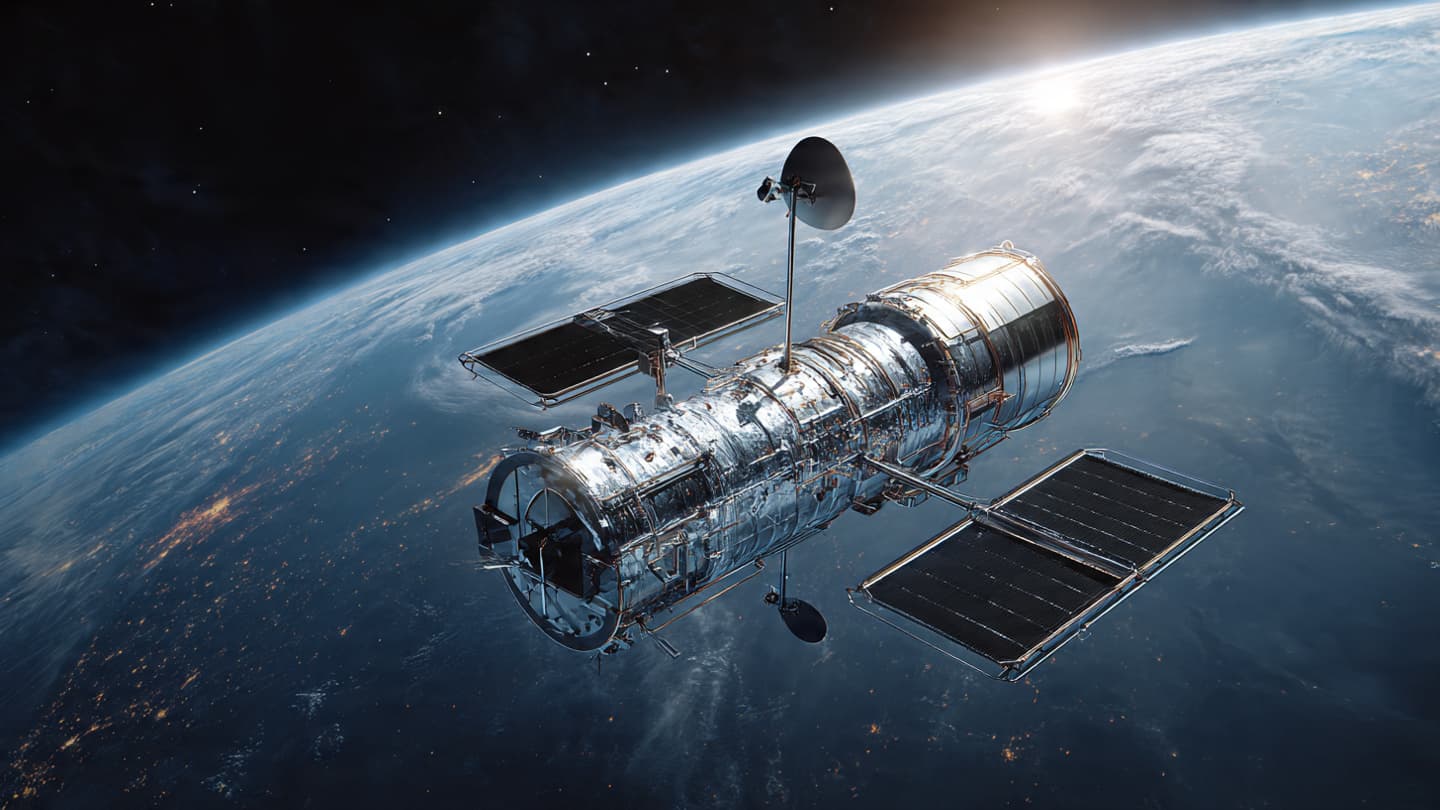
The story of great observatories is often a story about time. Some instruments arrive quietly, perform beyond expectations, and remain in service long enough to witness generations of discovery. Floating hundreds of miles above Earth, the Hubble Space Telescope has become one of those rare scientific companions, continuing to reveal the universe long after many expected its mission to end.
More than three decades after its launch in 1990, Hubble remains one of the most productive scientific instruments ever built. Its observations have helped astronomers refine the age of the universe, study distant galaxies, and investigate the atmospheres of worlds beyond our solar system. The telescope's longevity has become a remarkable achievement in modern space exploration.
Recent discussions within NASA have focused on the possibility of raising, or "reboosting," Hubble's orbit. Over time, Earth's upper atmosphere creates a small amount of drag that gradually lowers the telescope's altitude. Although the process is slow, maintaining a higher orbit could potentially extend Hubble's operational life.
The concept gained public attention after studies examined whether commercial spacecraft could assist in a future reboost mission. Such an operation would require careful planning, engineering assessments, and financial justification before moving forward.
NASA officials have indicated interest in preserving Hubble's scientific capabilities, particularly if the cost of a reboost mission can be reduced to a practical level. Budget considerations remain a significant factor in determining whether such a mission proceeds.
The discussion reflects a broader shift in space operations. Government agencies increasingly evaluate partnerships with private aerospace companies to accomplish objectives that were once handled exclusively through government-led missions.
At the same time, Hubble continues producing valuable science. Researchers worldwide rely on its observations, often combining Hubble data with findings from newer observatories such as the James Webb Space Telescope. Together, these instruments provide complementary views of the cosmos.
For many astronomers, preserving Hubble is not simply about extending the life of a spacecraft. It is about maintaining a proven scientific platform that continues to contribute to discoveries despite its age.
NASA has not committed to a reboost mission, but agency officials remain interested in the concept if costs can be sufficiently reduced and technical requirements can be met. The telescope continues normal operations while future options are evaluated.
AI Image Disclaimer: This illustration was created with AI assistance to visually represent the topic and does not depict an actual NASA mission photograph.
Sources Verified NASA Space.com Reuters
Published by Banx Network. This article is part of the Banx decentralized media programme, powered by the BXE token on the XRP Ledger.