The sun has been the steady heartbeat of our solar system for billions of years, a constant source of light and warmth that has nurtured life on Earth. Yet, like all stars, it is not eternal. Astrophysics offers us a glimpse into a distant future, roughly five billion years from now, when our star will exhaust its nuclear fuel and undergo a dramatic transformation. This celestial evolution promises a fate for Earth that is both majestic and terrifying, reminding us of the transient nature of even the most enduring cosmic structures.
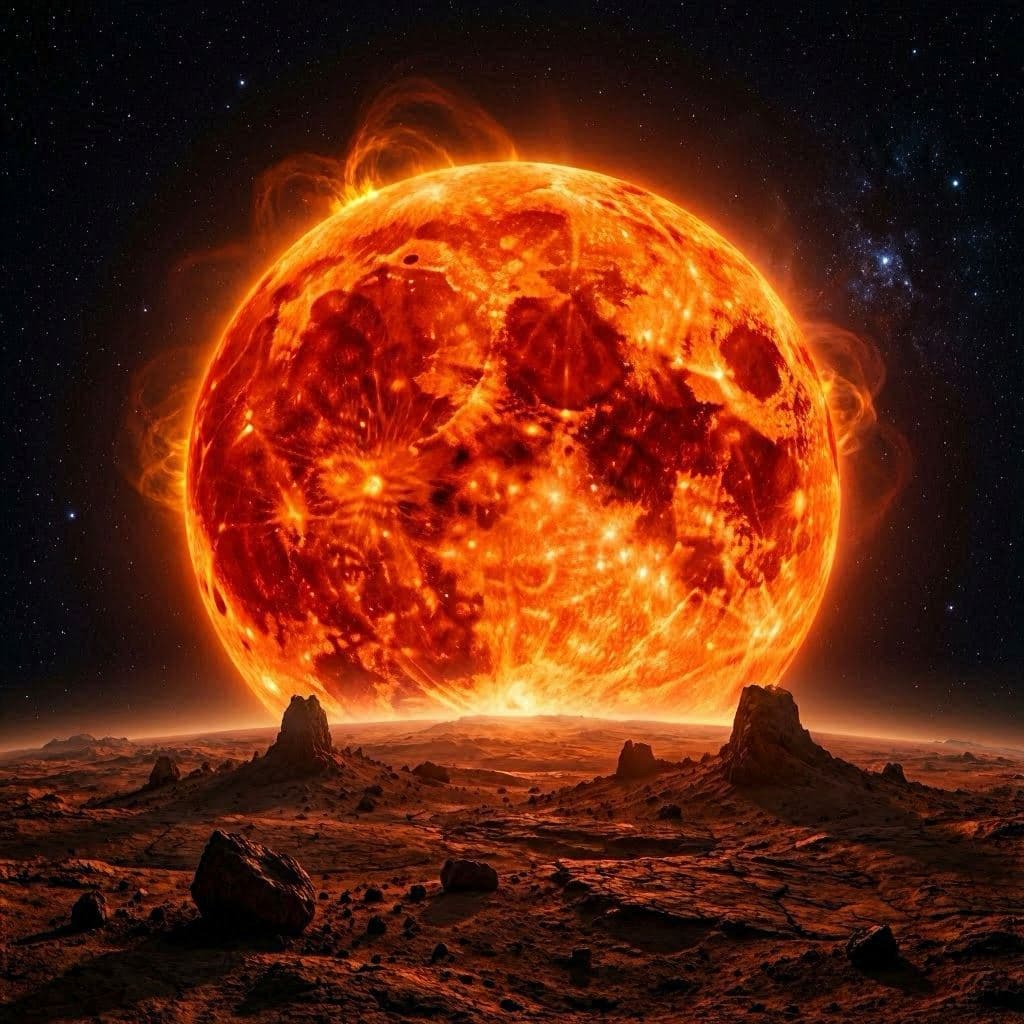
As the sun depletes its hydrogen reserves, it will begin to burn helium, causing its outer layers to expand significantly. It will swell into a red giant, growing so large that it may engulf the inner planets, including Mercury and Venus. For Earth, the outcome remains a subject of scientific debate. Some models suggest our planet will be swallowed whole, vaporized in the stellar inferno, while others propose that the sun’s loss of mass might allow Earth’s orbit to expand, potentially sparing it from immediate destruction.
Even if Earth escapes physical consumption, the conditions on its surface will become uninhabitable long before the sun reaches its maximum size. The increasing luminosity will boil away the oceans and strip the atmosphere, turning our blue marble into a barren, scorched rock. Life, as we know it, will have vanished eons prior, leaving behind a silent world that bears witness to the final chapters of its parent star.
Eventually, the red giant will shed its outer layers, creating a beautiful planetary nebula—a glowing shell of gas and dust that expands into space. At the center will remain the core of the sun, now a white dwarf. This dense, Earth-sized remnant will no longer generate energy through fusion but will slowly cool over trillions of years, fading from a bright white to a dim black dwarf. It is a quiet end to a violent process.
Recent studies using data from other dying stars help refine these predictions. By observing similar solar-mass stars in various stages of evolution, astronomers can piece together a more accurate timeline for our own sun’s demise. These observations confirm that while the process is inevitable, it is also slow and gradual on human timescales, offering no immediate cause for alarm but plenty of food for philosophical reflection.
The knowledge of this eventual end does not diminish the value of our present moment; rather, it enhances it. Understanding the lifecycle of stars connects us to the broader universe, placing our existence within a grand cosmic narrative. It invites us to appreciate the rare and precious window of time in which our planet is habitable, fostering a sense of stewardship for the environment we currently enjoy.
For humanity, the timeline is so vast that it transcends immediate concern. Our species’ legacy will likely be determined by much nearer challenges and opportunities. Whether we survive as a civilization or spread to other stars, the fate of Earth serves as a ultimate boundary condition for our story. It challenges us to think beyond our lifetimes and consider our place in the deep time of the cosmos.
In the end, the death of the sun is not just an astronomical event but a profound reminder of change. It teaches us that nothing lasts forever, not even the stars. By accepting this truth, we can find a deeper appreciation for the light we have now, cherishing the warmth and life it provides while it lasts.
AI Image Disclaimer: The visual elements accompanying this piece are generated by artificial intelligence to provide conceptual context and do not depict real-world simulations or actual future events.
Sources: NASA Science Magazine The Guardian Space.com European Space Agency (ESA)
Published by Banx Network. This article is part of the Banx decentralized media programme, powered by the BXE token on the XRP Ledger.