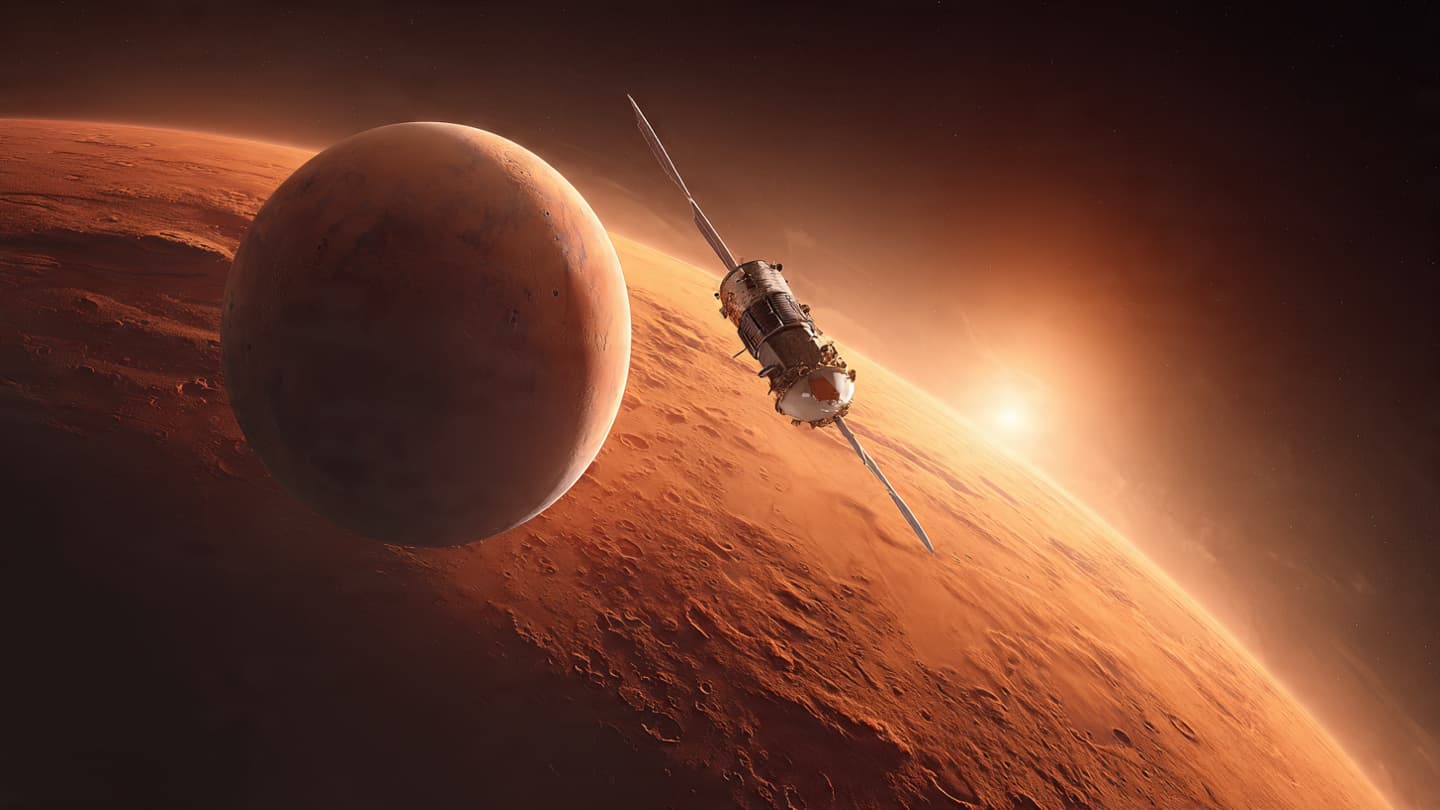
Space exploration often unfolds through long journeys interrupted by brief moments of extraordinary clarity. A spacecraft may travel for years through darkness and silence before suddenly capturing images that reshape how humanity sees familiar worlds. Recently, a deep-space probe heading toward a distant asteroid offered one such moment as it passed near Mars and returned striking new photographs of the planet.
The spacecraft used its flyby to gather scientific data and test imaging systems while gaining gravitational assistance for its longer mission deeper into the Solar System. During the encounter, the probe captured high-resolution images of Mars, including detailed surface features, atmospheric conditions, and views of the planet’s rugged terrain.
Scientists involved in the mission described the images as both scientifically valuable and visually remarkable. Modern spacecraft cameras can now reveal subtle geological textures, dust patterns, and lighting conditions with unprecedented precision, helping researchers better understand the Martian environment.
Flybys serve an important role in space missions because they allow spacecraft to conserve fuel while increasing speed through gravitational assistance. By carefully navigating around planets, probes can redirect their trajectories toward more distant targets that would otherwise require far greater propulsion resources.
The asteroid destination itself is expected to provide insight into the early history of the Solar System. Many asteroids preserve ancient material left over from planetary formation billions of years ago. Studying them helps scientists investigate how planets formed and how water and organic compounds may have spread across space.
Mars continues to occupy a central place in planetary science because of evidence suggesting it once possessed rivers, lakes, and a thicker atmosphere. Every new observation contributes additional detail to understanding how the planet evolved from a wetter ancient world into the colder environment seen today.
The images also highlight how interconnected space missions often become. A spacecraft designed for one scientific target can still produce valuable discoveries during its journey, gathering information from planets, moons, and other celestial objects encountered along the way.
Public interest in planetary imagery remains strong because photographs from deep space carry emotional as well as scientific significance. They transform distant worlds from abstract points of light into landscapes with texture, weather, and history.
Mission teams are expected to continue analyzing the Mars flyby data while the probe proceeds toward its asteroid destination, where further scientific observations are planned in the years ahead.
AI Image Disclaimer: Some visual enhancements related to this article were produced using AI-assisted rendering techniques.
Sources: NASA European Space Agency Space.com Reuters Planetary Society
Published by Banx Network. This article is part of the Banx decentralized media programme, powered by the BXE token on the XRP Ledger.