
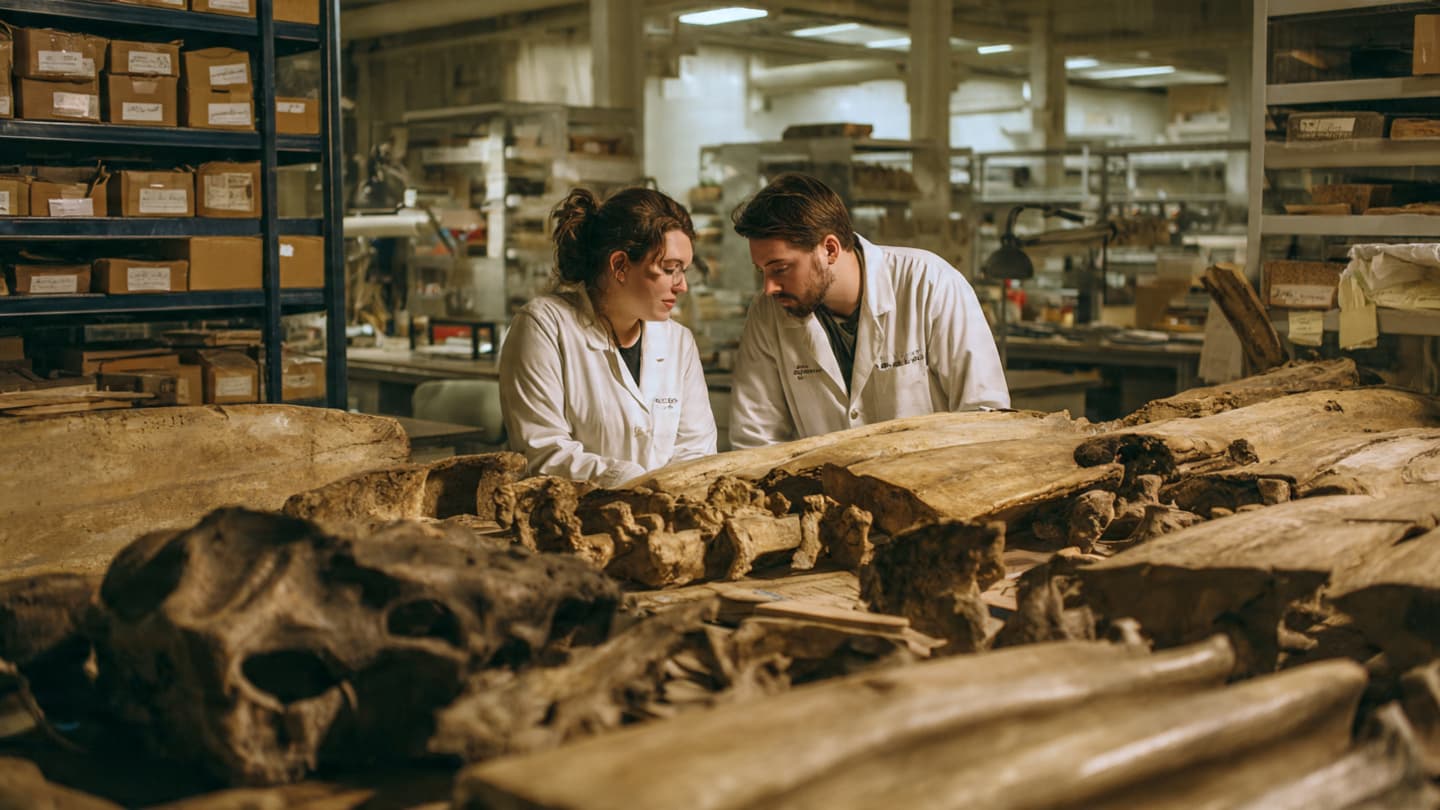
Museums are often described as places where history rests safely behind glass, preserved against the erosion of time. Yet science rarely stands still inside those quiet rooms. Sometimes, discoveries emerge not from new excavations but from old shelves, where forgotten labels wait patiently to be questioned again.
For nearly seventy years, a collection of large bones housed in Alaska was believed to belong to woolly mammoths that once roamed the Ice Age landscape of Beringia. The remains had been discovered in the 1950s near Fairbanks, an area already well known for yielding fossils of mammoths, bison, and other prehistoric megafauna. Because of their size and location, the identification appeared reasonable for decades.
Recent scientific analysis, however, revealed that the fossils were not mammoth remains at all. Researchers conducting radiocarbon dating noticed something unusual: the bones were far younger than expected for Ice Age mammoths. Further chemical and DNA testing eventually confirmed that the remains actually belonged to whales — specifically a minke whale and a North Pacific right whale.
The discovery surprised researchers not only because of the mistaken identity, but also because the bones had been stored and cataloged for generations without major challenge. Yet such corrections are not uncommon in paleontology and archaeology. Scientific understanding evolves as technology improves, allowing researchers to revisit older collections with sharper tools and more refined methods.
Questions now surround how whale remains ended up deep in Alaska’s interior, far from the ocean. Researchers have proposed several possibilities, including natural transport, human activity, or errors during early cataloging and storage. For now, no single explanation has fully resolved the mystery, leaving room for continued investigation.
The story also reflects the patient nature of scientific inquiry. Fossils do not arrive with certainty attached to them. Early researchers often worked with limited dating methods and incomplete comparative records. What once appeared obvious may later reveal hidden complications when examined under modern analytical techniques.
There is also a quieter lesson beneath the headlines. Science advances not only through breakthroughs, but through revision. Discoveries gain strength when researchers remain willing to question assumptions, revisit earlier conclusions, and accept corrections without embarrassment. In many ways, uncertainty itself becomes part of the process.
The corrected identification may still provide scientific value. Whale remains from northern regions can offer insights into marine ecosystems, migration patterns, and environmental conditions from centuries past. Even mistaken labels, once reconsidered, may open unexpected paths for future research.
Researchers say the case demonstrates the importance of continued museum analysis and modern testing methods in paleontology and archaeology. The findings were discussed in connection with recent studies revisiting long-held fossil classifications.
AI Image Disclaimer: Certain visual elements related to prehistoric animals and fossils were created with AI-generated artistic interpretation.
Sources: New York Post, Smithsonian Magazine, Journal of Quaternary Science
Published by Banx Network. This article is part of the Banx decentralized media programme, powered by the BXE token on the XRP Ledger.



