Space exploration often advances through moments that appear quiet from Earth. Far from crowded cities and political debate, engineers and scientists spend years solving problems measured not in footsteps, but in millions of miles. This week, researchers announced progress on one such challenge: a complex spacecraft navigation puzzle involving how probes travel efficiently between asteroids in deep space.
The problem centered on orbital mechanics, the delicate mathematics governing how objects move under gravity. Unlike direct missions to planets, asteroid-hopping spacecraft must navigate constantly shifting paths while conserving limited fuel supplies. Even minor adjustments can dramatically alter mission costs and duration.
Scientists explained that the new solution improves how spacecraft calculate transfers between multiple asteroids. By identifying more efficient gravitational pathways, future missions may be able to explore several targets without requiring excessive propulsion. In practical terms, the breakthrough could extend mission lifespans and reduce engineering constraints.
Asteroids hold growing scientific interest because they preserve material dating back to the early solar system. Many researchers describe them as cosmic archives, containing clues about planetary formation and the chemical conditions that existed billions of years ago. Visiting multiple asteroids during a single mission therefore carries significant scientific value.
The navigation challenge itself resembled a celestial balancing act. Spacecraft moving between asteroids must account for the gravitational influence of the Sun, planetary bodies, and the asteroids themselves. Researchers used advanced computational modeling to predict routes that remain stable over long periods while minimizing energy consumption.
The achievement also reflects a broader shift in modern space exploration. Missions are becoming increasingly ambitious, moving beyond single-destination objectives toward flexible exploration strategies. Space agencies and private aerospace companies alike are seeking ways to maximize scientific return while controlling operational costs.
Several scientists involved in the work noted that such mathematical solutions rarely attract public attention despite playing essential roles in exploration. Spectacular rocket launches often become symbolic milestones, yet quieter breakthroughs in navigation and engineering are what ultimately allow spacecraft to survive and adapt in deep space.
The findings may also support future planetary defense efforts. Efficient asteroid navigation techniques could improve humanity’s ability to study near-Earth objects more closely, especially those that require long-duration tracking or potential deflection planning in the future.
As research continues, the newly developed approach is expected to influence upcoming asteroid missions and deepen scientific understanding of how spacecraft can travel more effectively through the complex architecture of the solar system.
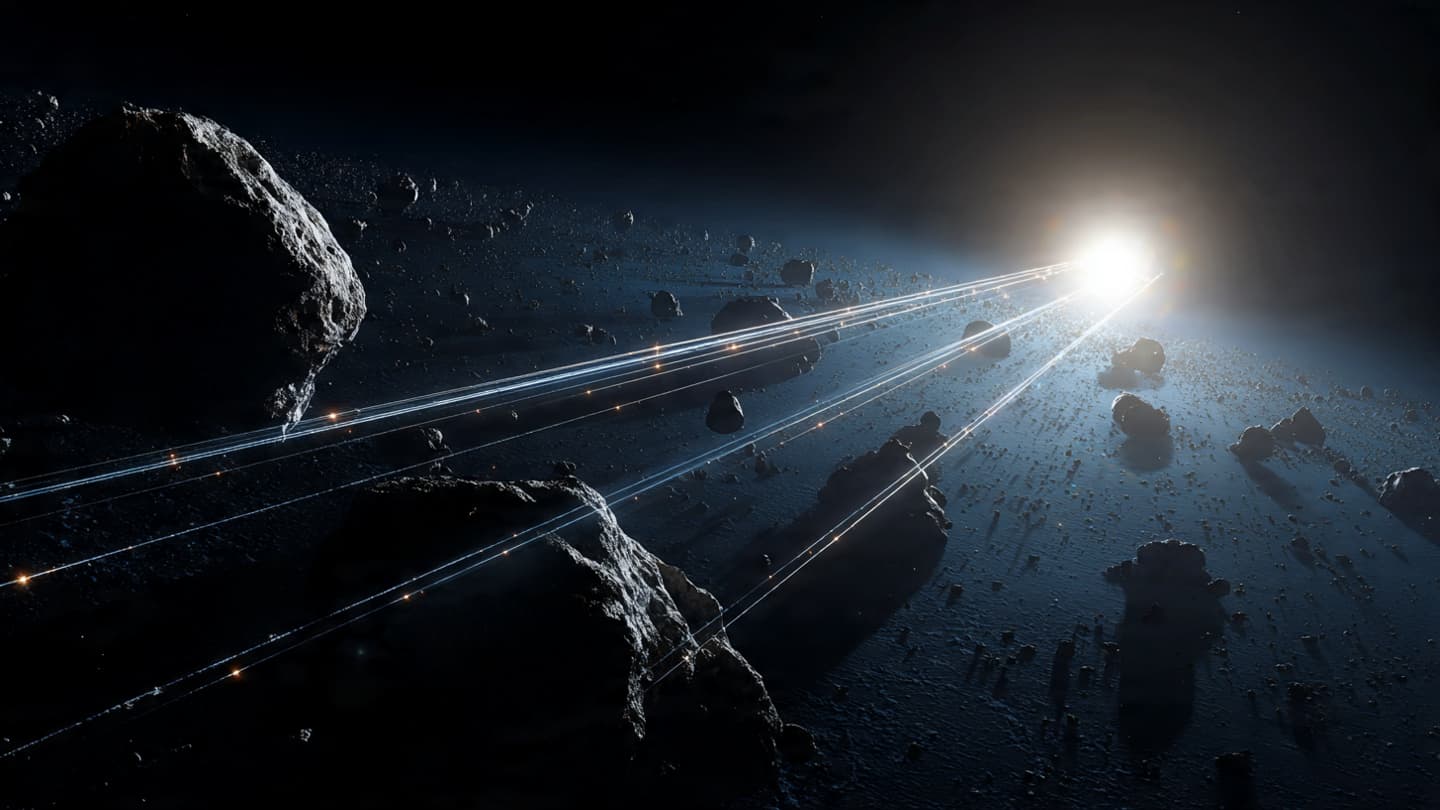
AI Image Disclaimer: Some visual materials associated with this article were generated with AI-assisted illustration technology.
Sources: Space.com, Reuters, Scientific American, New Scientist
Published by Banx Network. This article is part of the Banx decentralized media programme, powered by the BXE token on the XRP Ledger.