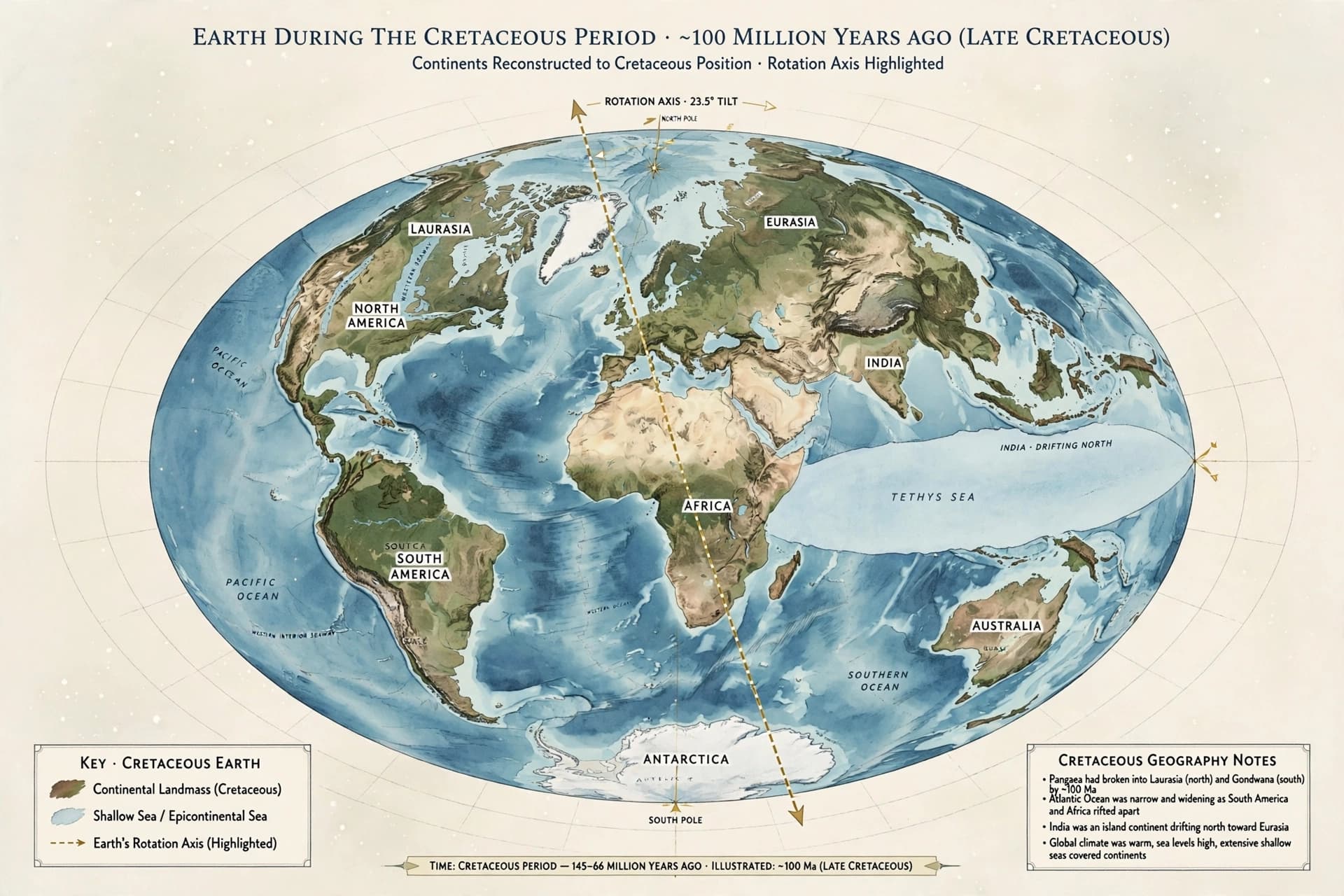
Earth does not pull evenly everywhere. Beneath oceans and continents, hidden variations in the planet’s interior subtly alter the force of gravity itself. For decades, one of the strangest examples has existed beneath the Indian Ocean, where scientists identified a massive region sometimes described as a gravitational “hole.” Now, researchers believe they may finally have a clearer explanation for the long-standing geological mystery.
The anomaly, formally known as the Indian Ocean Geoid Low, represents one of the weakest gravitational regions on Earth. Satellites measuring Earth’s gravitational field revealed that sea levels in the area are lower than average because the underlying gravitational pull is unusually weak compared to surrounding regions.
Scientists have debated the cause of the phenomenon for years. Recent research suggests that the anomaly may be linked to ancient geological processes deep within Earth’s mantle, the vast layer of semi-solid rock located between the crust and the planet’s core.
According to researchers, remnants of an ancient oceanic plate that sank into the mantle millions of years ago may have disrupted the distribution of dense material beneath the Indian Ocean. Hot, low-density plumes rising upward through the mantle may also contribute to the weakened gravitational field observed today.
The findings provide new insight into how Earth’s interior continues evolving over immense periods of geological time. Although the planet’s surface appears relatively stable on human timescales, tectonic plates and mantle structures remain in constant motion beneath continents and oceans.
Understanding gravitational anomalies is important not only for geology but also for satellite navigation, oceanography, and climate science. Precise gravitational measurements help scientists study sea-level changes, tectonic movement, and the behavior of Earth’s deep internal structures.
Researchers used advanced computer simulations and geological reconstructions to test possible explanations for the anomaly. By recreating ancient tectonic movements, scientists were able to model how deep mantle processes may have gradually produced the unusual gravitational conditions beneath the Indian Ocean.
While scientists continue refining their understanding of the anomaly, the latest findings offer one of the strongest explanations yet for a mystery that has challenged geophysicists for decades. Beneath the calm surface of the ocean, Earth’s interior continues carrying traces of an ancient geological history still shaping the planet today.
AI Image Disclaimer: Some images associated with this report were AI-generated to visualize Earth’s gravitational field and deep mantle activity beneath the Indian Ocean.
Sources: Nature Geoscience, ScienceDaily, NASA Earth Observatory, New Scientist
Published by Banx Network. This article is part of the Banx decentralized media programme, powered by the BXE token on the XRP Ledger.