The natural world often whispers its most surprising stories through its smallest creatures. A bumblebee drifting between flowers may appear to be guided solely by instinct, moving through a familiar rhythm that has repeated for countless generations. Yet recent scientific findings suggest that beneath those delicate wings lies a capacity for problem-solving that challenges long-standing assumptions about intelligence itself.
Researchers have discovered that bumblebees can solve novel problems in ways previously associated with animals known for their cognitive abilities, including chimpanzees and elephants. The findings add a new chapter to an expanding understanding of animal intelligence and demonstrate that complex behavior is not reserved exclusively for large-brained species.
The study adapted a classic experiment first used more than a century ago with chimpanzees. In that original setup, animals had to manipulate objects to reach a reward positioned just beyond their immediate grasp. Similar experiments have since been conducted with birds and elephants, becoming a benchmark for evaluating spontaneous problem-solving abilities.
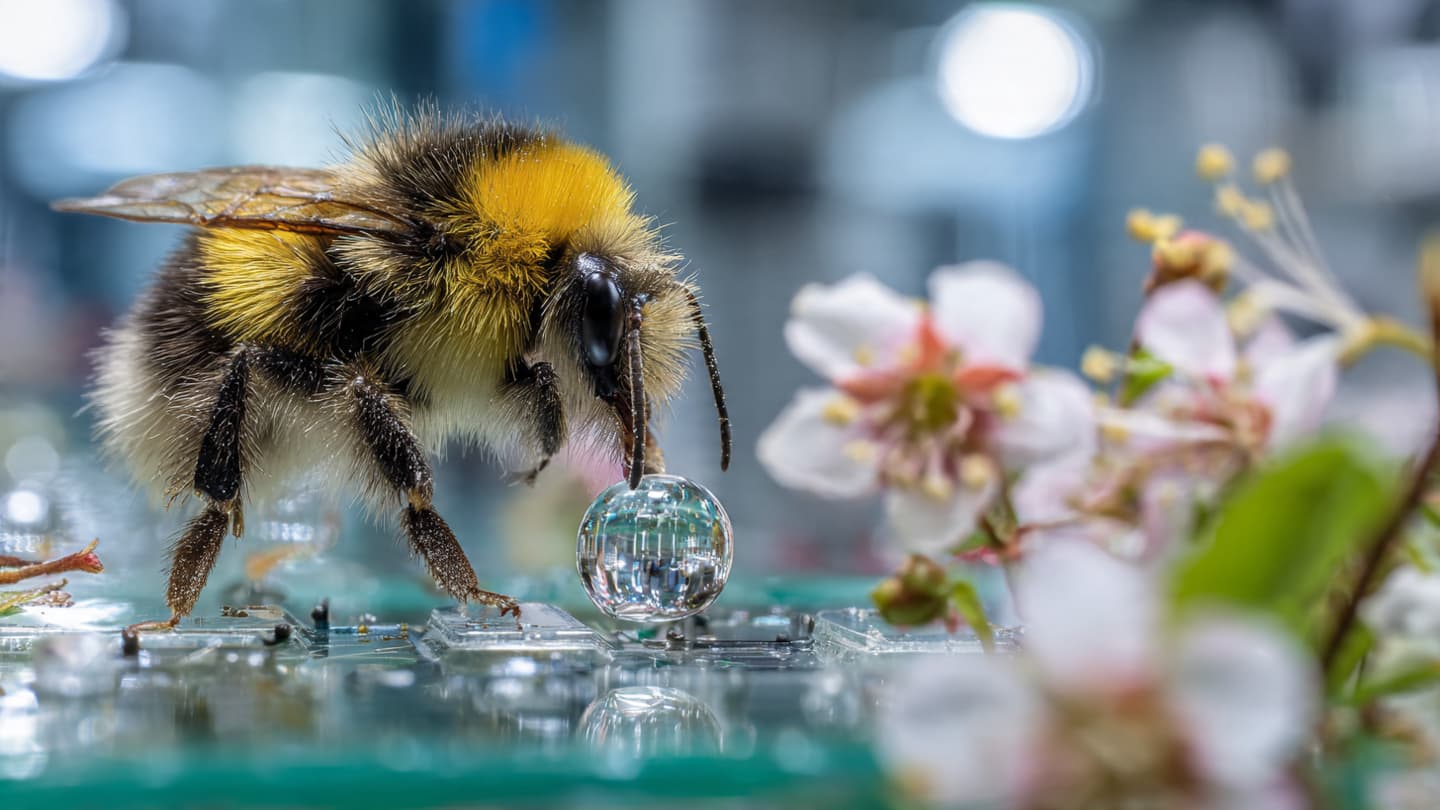
In the new research, bumblebees faced a challenge involving a small ball and a reward placed above them. Without receiving direct training on the solution, many of the insects learned to move the ball into position and use it as a platform to reach the reward. Their success suggested more than random movement or simple repetition.
Scientists were particularly interested in determining whether the bees truly understood aspects of the task. To test this, researchers introduced barriers and altered visual cues. Even under these modified conditions, a significant proportion of the insects successfully completed the challenge, indicating a degree of flexibility in their behavior.
The findings contribute to a growing body of evidence that insects can display sophisticated behaviors. Previous studies have shown that bumblebees can learn from one another, use simple tools, and adapt to changing environments. Together, these observations suggest that intelligence may emerge in many forms across the animal kingdom.
Rather than viewing cognition as a ladder with humans at the top and insects near the bottom, scientists increasingly describe intelligence as a collection of specialized abilities shaped by evolutionary needs. For a bumblebee navigating flowers, weather, predators, and competition, efficient problem-solving may be just as valuable as a larger brain would be.
The research also raises broader questions about how intelligence is measured. Brain size alone may not fully explain cognitive performance. Instead, the organization and efficiency of neural systems could play a crucial role in enabling animals to interact successfully with complex environments.
As scientists continue exploring the capabilities of insects, the humble bumblebee offers a reminder that nature often conceals remarkable abilities in unexpected places. What appears small and simple from a distance can reveal surprising complexity when examined more closely.
AI Image Disclaimer: The accompanying illustration for this article is AI-generated and intended solely as a visual interpretation of the reported topic.
Sources (Verified):
KPBS Public Media Georgia Public Broadcasting Science Journal (as cited by reporting outlets) Times of India
Published by Banx Network. This article is part of the Banx decentralized media programme, powered by the BXE token on the XRP Ledger.