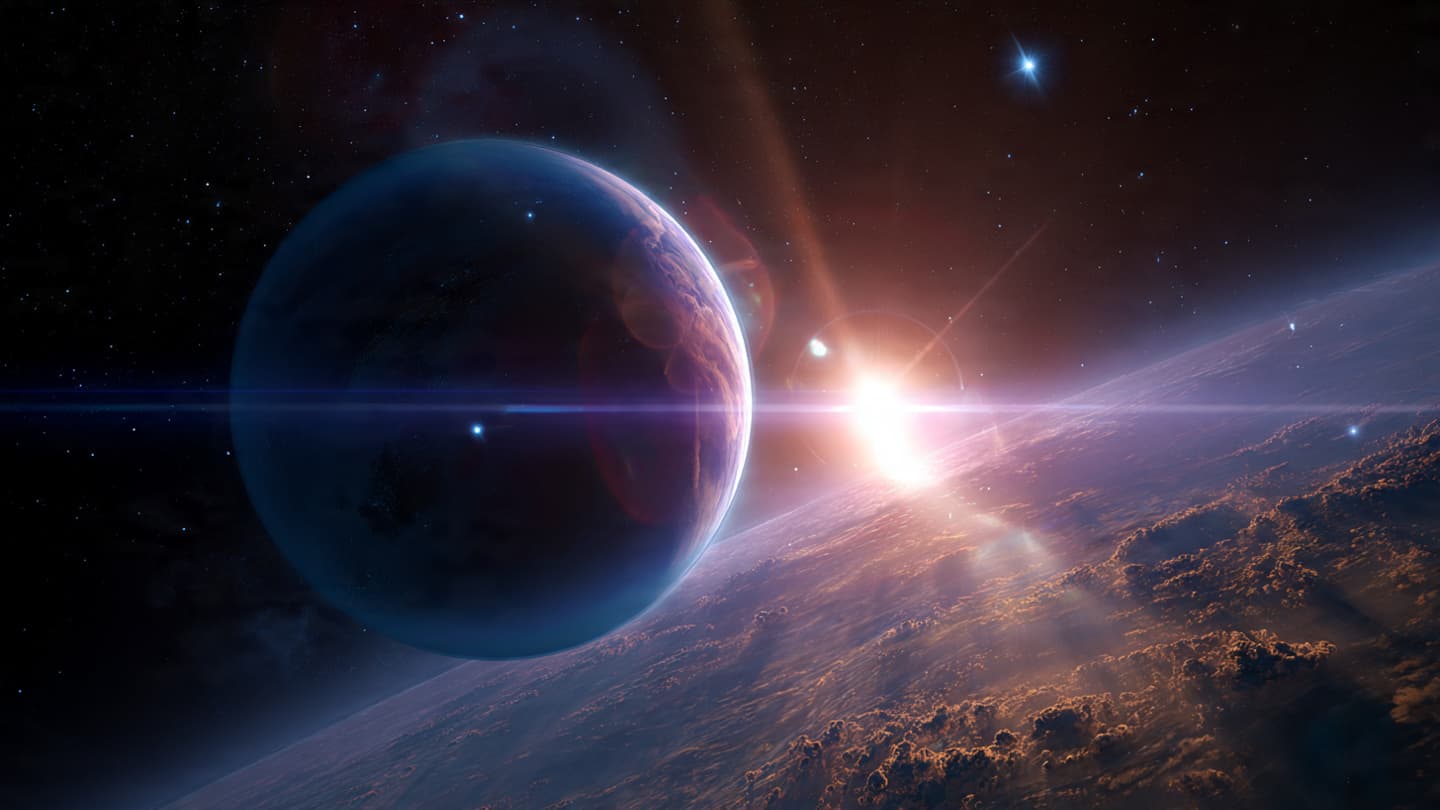
From a distance, it appears familiar. Suspended against the darkness of space, the planet shines with a deep blue hue that evokes images of Earth viewed from orbit. Yet appearances can be remarkably deceptive. Roughly 63 light-years away, an exoplanet known as HD 189733b presents one of the most extreme environments ever studied beyond the Solar System.
Body
HD 189733b belongs to a class of worlds known as “hot Jupiters,” giant gas planets that orbit extremely close to their host stars. Its proximity to its star subjects the planet to intense heating, producing atmospheric temperatures that exceed 1,000 degrees Celsius.
The planet gained international attention after observations from the Hubble Space Telescope revealed its striking blue appearance. Unlike Earth, whose color largely comes from oceans and atmospheric effects, HD 189733b owes its color to silicate particles suspended in its atmosphere.
These silicate particles contribute to one of the planet’s most extraordinary weather phenomena. Scientists believe conditions are hot enough for silicate materials to form molten droplets, creating a form of glass rain unlike anything found in the Solar System.
The weather becomes even more remarkable when wind speeds are considered. Observations indicate atmospheric winds reaching approximately 7,000 kilometers per hour, fast enough to drive the molten glass sideways rather than allowing it to fall vertically.
Researchers have also found that the planet is tidally locked, meaning one hemisphere continually faces its star while the opposite side remains in darkness. This arrangement contributes to extreme temperature contrasts and powerful atmospheric circulation.
Although inhospitable, HD 189733b serves as an important laboratory for planetary science. By studying such extreme environments, astronomers can better understand atmospheric chemistry, weather systems, and the diversity of planets throughout the galaxy.
The planet remains one of the most extensively observed exoplanets due to its relative proximity and favorable alignment. Its repeated transits across its host star provide valuable opportunities for scientists to analyze its atmosphere in detail.
Closing
HD 189733b demonstrates that familiar appearances can conceal profoundly different realities. Though its blue color may resemble Earth from afar, its scorching temperatures, glass-filled atmosphere, and supersonic winds reveal a world unlike any known environment on our own planet.
AI Image Disclaimer: All accompanying illustrations are AI-generated artistic representations based on published scientific descriptions.
Sources Verified:
NASA ESA Space.com
Published by Banx Network. This article is part of the Banx decentralized media programme, powered by the BXE token on the XRP Ledger.