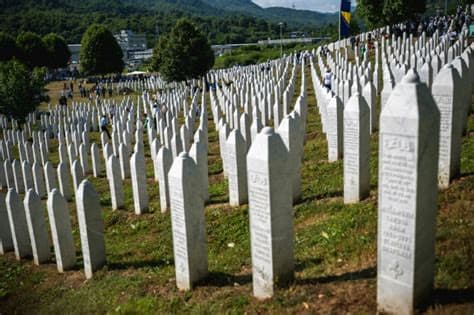
The article describes the annual Srebrenica–Potočari remembrance as a moment for laying victims to rest and renewing public commitment to truth, noting that families continue burial processes more than three decades later. Against this backdrop, it says prominent political actors in Serbia and Republika Srpska—along with segments of media and the public—continue to deny that the genocide occurred as established by international courts.
It recounts how denial manifests through public statements and political strategies, including minimizing the number of victims, disputing responsibility, and re-framing the memorial site and survivor testimony as fraudulent. The article also links renewed denial to wider political tensions in Bosnia, describing how efforts to obstruct remembrance and promote genocide denial have become intertwined with nationalist movements and disputes over the country’s constitutional and political direction.
Finally, it emphasizes the impact on survivors and the memorial community: denial is portrayed not only as a historical dispute, but as the “next phase” of targeting that prolongs trauma and risks turning memory work into a battleground again—especially for younger generations encountering false narratives.
Published by Banx Network. This article is part of the Banx decentralized media programme, powered by the BXE token on the XRP Ledger.