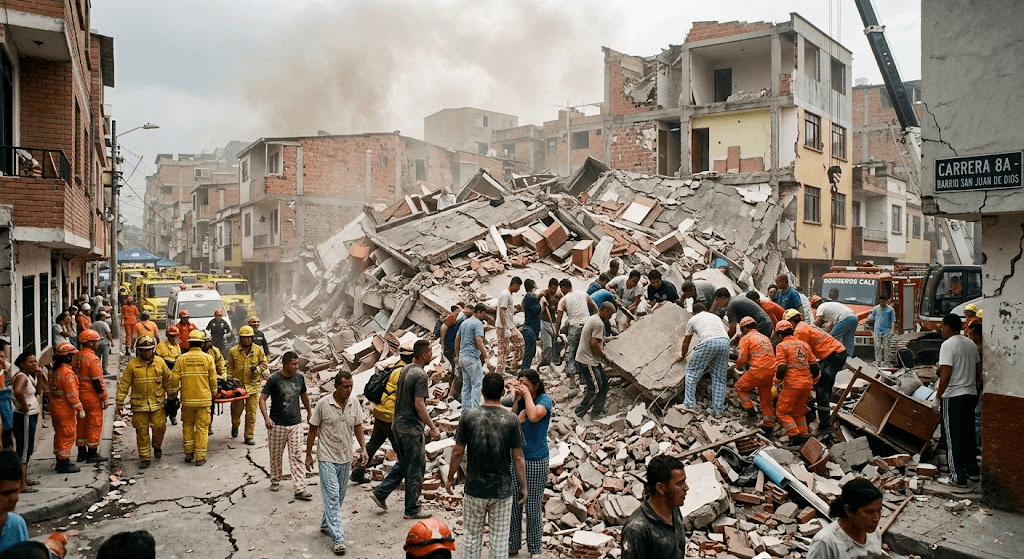
CALI, COLOMBIA — A violent magnitude 7.4 earthquake struck western Colombia on Monday morning, August 10, 2026 killing at least 111 people, injuring dozens more, and reducing scores of structures to rubble across multiple major cities. Ground shaking brought down at least 61 buildings, prompting emergency crews and civilian volunteers to launch desperate search-and-rescue operations for survivors trapped beneath concrete debris.
The Colombian Geological Service confirmed that the temblor was the strongest recorded in the nation in the 21st century.
The epicenter near San José del Palmar, a remote mountainous municipality in the Pacific department of Chocó, sent powerful shockwaves radiating across western Colombia. Tremors were felt hundreds of miles away in the capital of Bogotá, as well as across neighboring Ecuador, Panama, and Venezuela.
The heaviest casualties and structural damage were concentrated in the departments neighboring Chocó. In Risaralda, Pereira reported at least 40 fatalities, with panic erupting at Matecaña International Airport after sections of the passenger terminal roof caved in. Meanwhile, Valle del Cauca saw at least 27 people killed in Cali—Colombia's third-largest city—where dozens of structures suffered major damage or collapse, including the Hospital Universitario del Valle.
Additionally, in Caldas, the city of Manizales saw its neo-Gothic Metropolitan Cathedral Basilica, the tallest in the country; suffer severe destruction when one of its main towers collapsed onto the nave.
In the urban centers of Cali and Pereira, rescue workers raised their fists above their heads to signal crowds of volunteers for total silence, attempting to listen for faint taps or cries coming from beneath collapsed concrete slabs.
"The first priority is rescuing the people trapped under the rubble. The national government has all of its capabilities deployed to protect lives and assist affected communities."— Abelardo De La Espriella, President of Colombia
Newly inaugurated Colombian President Abelardo De La Espriella declared a national state of emergency to expedite emergency funding, clear roads, and mobilize military and first-responder assets to the affected departments.
Airports across six cities—including Pereira, Manizales, Quibdó, and Buenaventura—suspended flight operations to assess structural integrity on runways and terminals. Power outages, ruptured water lines, and downed communication networks continue to complicate rescue efforts as dozens of aftershocks ripple through the region.
Note: This article was published on BanxChange.com and is powered by the BXE Token on the XRP Ledger. For the latest articles and news, please visit BanxChange.com