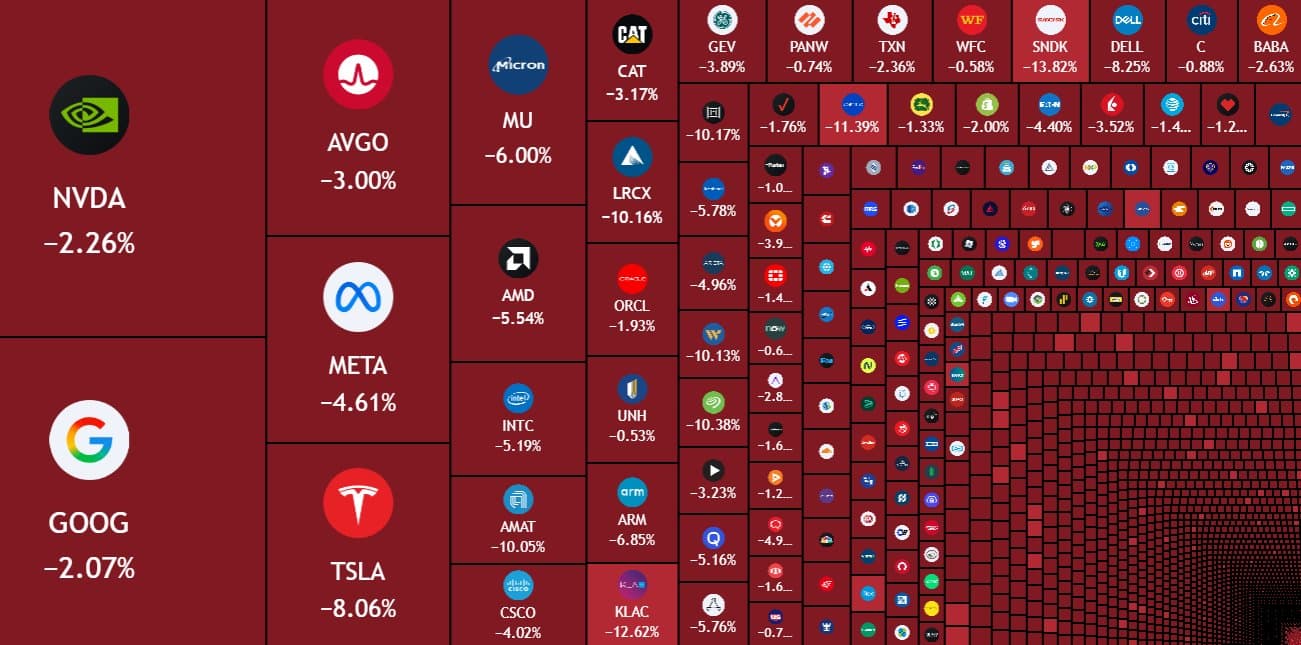
What It Means for Investors Shockwaves ripped through Wall Street as an estimated $1.25 trillion in market value disappeared within just three hours, triggering one of the most dramatic intraday sell-offs in recent memory. The steep decline sent investors scrambling, with major technology stocks leading the losses and fears of continued volatility spreading across global markets.
The market-wide sell-off was fueled by a combination of investor uncertainty, profit-taking, concerns over interest rates, and broader economic pressures. While fluctuations are a normal part of financial markets, the sheer size and speed of this decline captured the attention of traders, analysts, and everyday investors alike.
Technology giants—including Nvidia, Tesla, Meta, Alphabet (Google), AMD, Broadcom, and Micron—were among the hardest hit. These companies have been key drivers of the market's recent gains, meaning that even modest percentage declines translated into hundreds of billions of dollars being erased from their combined valuations.
One statistic making headlines is that the amount wiped from the market exceeds the total market capitalization of Bitcoin during many periods, highlighting the scale of the sell-off. While such comparisons are eye-catching, they also underscore just how enormous the U.S. stock market has become and how quickly investor sentiment can shift.
Market experts caution against making emotional decisions during periods of heightened volatility. Historically, stock markets have experienced sharp corrections before recovering over time. However, short-term uncertainty often creates opportunities for long-term investors while presenting significant risks for short-term traders.
Analysts are closely monitoring several factors that could influence the market's next move, including upcoming economic data, corporate earnings, inflation trends, and signals from the Federal Reserve regarding future interest rate policy. Any unexpected developments could either stabilize investor confidence or accelerate further market swings.
For retail investors, the recent decline serves as an important reminder that investing carries both risks and rewards. Diversification, disciplined investing, and maintaining a long-term perspective remain some of the most effective strategies during periods of uncertainty.
Despite the dramatic headlines, experienced investors understand that market corrections have occurred throughout history. Some have marked the beginning of prolonged downturns, while others have become buying opportunities before significant rebounds. The coming days will likely determine whether this sell-off represents a temporary pullback or the start of a broader market correction.
As markets continue to react to economic developments and investor sentiment, one thing is certain: volatility has returned, and every major move will be closely watched by investors around the world.
Published by Banx Network. This article is part of the Banx decentralized media programme, powered by the BXE token on the XRP Ledger.