
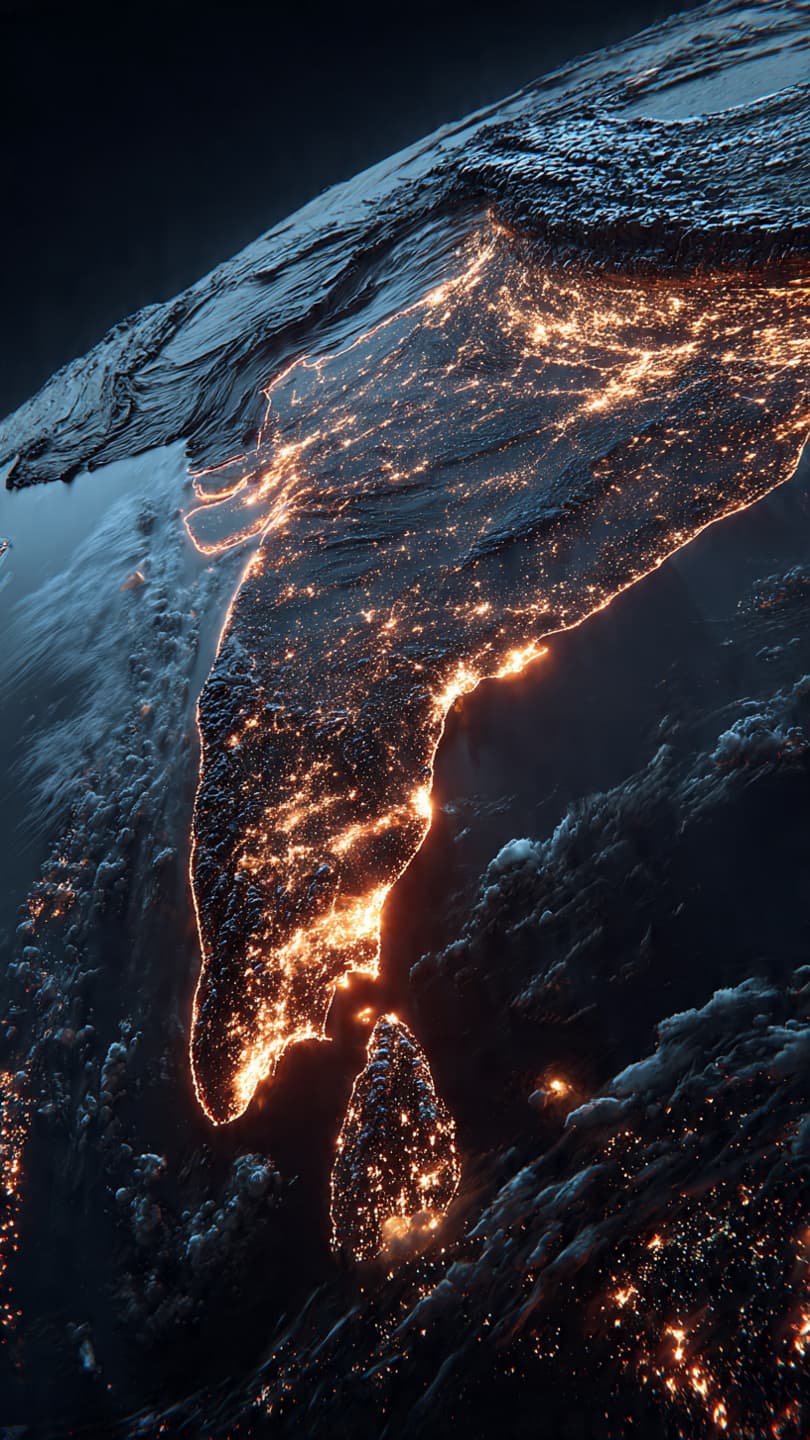
Earth does not pull equally everywhere.
The planet may appear smooth and spherical from space, but its gravity fluctuates subtly across different regions depending on:
Density deep underground Mantle movement Tectonic structure Variations in planetary mass distribution One of the strangest examples of that phenomenon lies beneath the : a vast region where Earth’s gravitational pull is measurably weaker than surrounding areas.
Known as the , the anomaly has remained one of geophysics’ enduring mysteries for decades.
Now researchers believe they may finally have a plausible explanation.
What Is the Indian Ocean Geoid Low? The anomaly is often described informally as a “gravity hole,” though the term can sound more dramatic than the underlying physics.
In reality, scientists measure Earth’s gravity using something called the geoid — an imaginary global sea-level surface shaped by gravitational strength.
In the Indian Ocean region, that surface dips unusually low because gravity there is weaker than expected.
The anomaly spans a massive area south of India and represents one of the largest known gravitational irregularities on Earth.
Satellite measurements show the region contains less gravitational mass influence compared with surrounding areas.
The New Explanation Recent geophysical modeling suggests the anomaly may be connected to ancient structures deep inside Earth’s mantle.
Researchers believe the weakened gravity could result from:
Low-density magma plumes Sinking remnants of ancient tectonic plates Mantle circulation patterns Deep interior material displacement Some models indicate the phenomenon may trace back to tectonic events occurring millions of years ago when the ancient Tethys Ocean disappeared and tectonic plates shifted dramatically beneath the region.
Essentially, Earth’s interior may still carry the long-term gravitational signature of ancient geological processes.
Earth’s Interior Is Constantly Moving One reason the mystery persisted for so long is because humans cannot directly observe most of Earth’s deep interior.
The mantle beneath Earth’s crust behaves over long timescales almost like extremely slow-moving fluid.
Heat from Earth’s core drives convection currents that gradually reshape:
Tectonic plates Ocean basins Volcanic systems Density distribution inside the planet These movements occur over millions of years, making them extraordinarily difficult to reconstruct precisely.
Modern supercomputer simulations now allow scientists to model these ancient interior flows more effectively than before.
Why Gravity Anomalies Matter Understanding gravitational irregularities is important for more than scientific curiosity alone.
Gravity mapping helps support:
Satellite navigation Oceanography Climate research Geological modeling Earthquake studies Sea-level measurements Even subtle gravitational differences influence how water distributes across the planet’s oceans.
Studying anomalies like the Indian Ocean Geoid Low also helps scientists better understand how Earth evolved internally across geological time.
The Planet Beneath the Planet One of the most fascinating aspects of geology is that the Earth humans experience daily represents only a thin outer layer above an enormously dynamic interior.
Beneath the crust:
Rock slowly circulates Ancient plates descend into the mantle Heat reshapes planetary structure Density shifts alter gravity itself The surface world of continents and oceans is therefore connected to deep planetary processes unfolding far below human visibility.
The Indian Ocean anomaly is one of the clearest reminders of that hidden complexity.
A Wider Reflection The phrase “gravity hole” captures public imagination partly because it sounds almost like science fiction — a mysterious invisible region hidden beneath the ocean.
But the reality may be even more remarkable.
The anomaly appears to be a planetary memory: a lingering physical imprint left by ancient tectonic movements deep inside Earth over immense stretches of time.
In a sense, gravity itself becomes a historical record.
The planet remembers where continents moved, where oceans vanished, and where ancient slabs of crust descended into the mantle millions of years ago.
And perhaps that is what makes the Indian Ocean mystery so compelling: it reveals that even something as seemingly constant as gravity carries traces of Earth’s deep and restless past.
AI Image Disclaimer Images are AI-generated illustrations and are intended for visual representation only, not real-world documentation.
Source Check Scientists studying the so-called say new research may finally explain the enormous gravitational anomaly beneath the , a phenomenon that puzzled geophysicists for decades.
Note: This article was published on BanxChange.com and is powered by the BXE Token on the XRP Ledger. For the latest articles and news, please visit BanxChange.com