
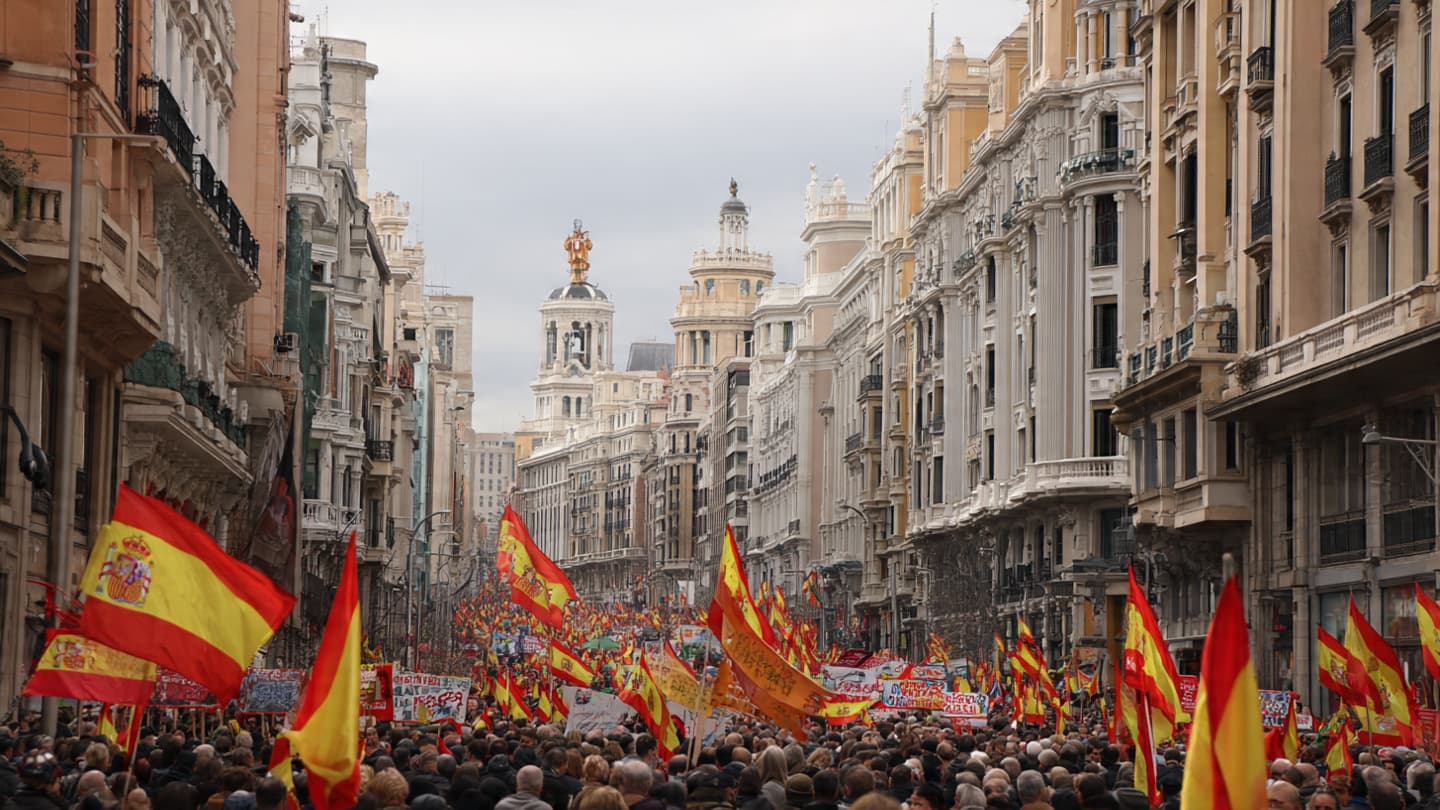
Cities often reveal their deepest tensions not through silence, but through footsteps. On the broad avenues of Madrid, where history lingers between old stone buildings and modern government offices, tens of thousands of demonstrators gathered carrying banners, flags, and frustrations shaped by months of political debate. The movement unfolded not with sudden eruption alone, but with the steady rhythm of public dissatisfaction seeking visibility.
The protest centered on demands for the resignation of Spanish Prime Minister Pedro Sánchez, whose government has faced criticism from opposition groups over controversial political agreements and broader concerns surrounding governance. Demonstrators filled parts of the Spanish capital as political slogans echoed through public squares under heavy media attention.
Organizers described the march as a defense of democratic principles and institutional trust. Opposition leaders accused the government of making concessions that weakened confidence in Spain’s political framework, particularly regarding negotiations involving Catalan separatist parties. Supporters of the administration, meanwhile, argued that dialogue and political compromise remain necessary in a deeply divided political environment.
Spanish politics has experienced increasing polarization in recent years, reflecting broader trends visible across Europe and other democratic nations. Coalition governments, regional independence debates, and economic pressures have contributed to a political climate where public demonstrations have become more frequent and emotionally charged.
Authorities monitored the gathering closely while maintaining security throughout central Madrid. Reports from local media indicated that the protest remained largely peaceful despite the scale of participation. Demonstrators traveled from different regions of Spain, carrying national flags and messages calling for accountability and political change.
Political analysts noted that public demonstrations play a longstanding role in Spain’s democratic tradition. Since the country’s transition from dictatorship to democracy in the late twentieth century, large marches have repeatedly served as visible expressions of civic pressure during periods of national disagreement.
At the same time, observers cautioned against reducing Spain’s political reality to a single protest alone. The country remains politically diverse, with significant portions of the population continuing to support the current government and its coalition approach. Elections, parliamentary negotiations, and public debate are expected to continue shaping Spain’s direction in the coming months.
For now, the march in Madrid stands as another reminder of how democratic societies often navigate uncertainty in public view. Beneath the banners and speeches lies a broader story about trust, representation, and the evolving relationship between governments and citizens across modern Europe.
AI Image Disclaimer: Some visuals associated with this article may include AI-generated editorial illustrations designed to support news presentation.
Sources: Reuters, BBC, El País, Associated Press, Euronews
Note: This article was published on BanxChange.com and is powered by the BXE Token on the XRP Ledger. For the latest articles and news, please visit BanxChange.com