
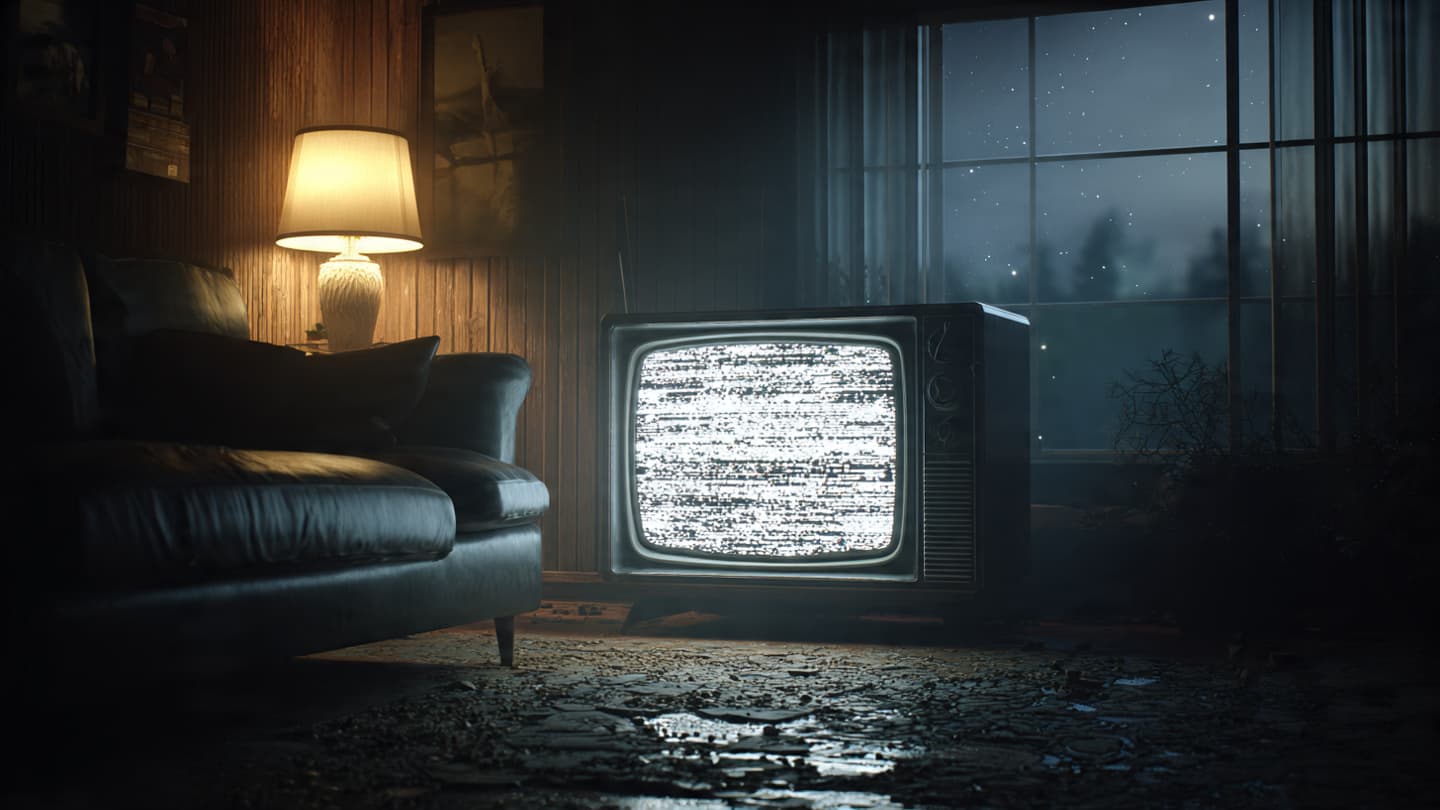
There was once a quiet ritual in households around the world: a television left untuned late at night, its screen flickering with restless black-and-white static. To many, it was simply noise — a meaningless shimmer dancing in empty air. Yet hidden within that familiar grain was something astonishingly ancient, a faint remnant of the universe’s earliest moments lingering unnoticed in living rooms for generations.
Scientists explain that a small fraction of old television static came from cosmic microwave background radiation, often described as the afterglow of the Big Bang. This radiation has traveled across space for nearly 13.8 billion years, carrying whispers from a time when the universe was still young, hot, and expanding rapidly after its creation.
The discovery of this cosmic signal dates back to the 1960s, when radio astronomers Arno Penzias and Robert Wilson detected unexplained background noise while working with a large antenna in New Jersey. What initially appeared to be technical interference eventually became one of the most important scientific discoveries of the modern era. Their findings provided powerful evidence supporting the Big Bang theory.
For decades afterward, traces of that ancient radiation unknowingly entered ordinary homes through analog television sets. Experts estimate that roughly one percent of untuned TV static was generated by cosmic microwave background radiation. The rest came from other atmospheric and electronic sources, but even that small fraction connected daily life to the distant beginnings of existence itself.
The idea continues to capture public imagination because of its unusual intimacy. Astronomy is often viewed as distant and abstract, measured through telescopes and spacecraft far removed from ordinary experience. Yet here was evidence that people had been casually observing ancient cosmic light while adjusting antennas or flipping through channels.
Researchers describe the cosmic microwave background as a kind of fossil light. It emerged approximately 380,000 years after the Big Bang, when the universe cooled enough for light to travel freely through space. Today, scientists use sensitive instruments and satellites to study these faint signals in remarkable detail, helping them better understand the universe’s age, structure, and evolution.
Modern digital televisions no longer produce the same visual static familiar to earlier generations, making the phenomenon feel almost historical now. Still, the story remains a reminder that science often hides within ordinary experiences, waiting quietly beneath the surface of everyday life.
Astronomers continue studying cosmic background radiation through advanced observatories and space missions. What once appeared as meaningless television snow is now recognized as one of humanity’s oldest visible connections to the birth of the universe.
AI Image Disclaimer: Some images accompanying this article may be AI-assisted visual interpretations created to illustrate scientific concepts.
Sources: NASA, BBC, Scientific American, Smithsonian Magazine, The New York Times
Note: This article was published on BanxChange.com and is powered by the BXE Token on the XRP Ledger. For the latest articles and news, please visit BanxChange.com